
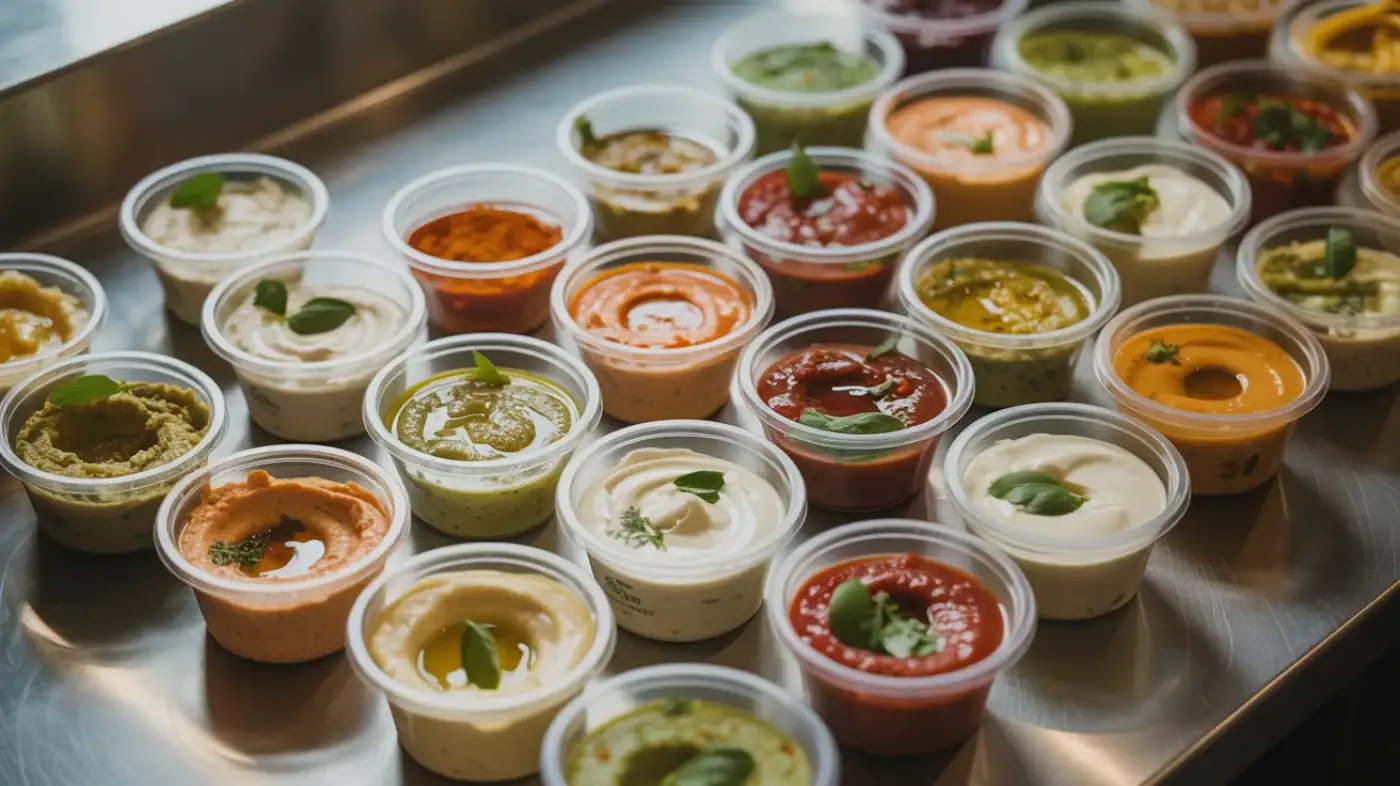
Chutney Filling Machine for Relish, Achaar and Condiment Cups
Fill chunky mango chutney, pickle relish, achaar and chow-chow into pre-formed cups and tubs, then seal and lid them on one rotary machine. Large-bore servo piston dosing holds ±0.5% from 50 g to 500 g.
A chutney filling machine deposits a set weight of chunky, acidic condiment such as mango chutney, sweet pickle relish or achaar into ready-made cups or tubs and seals them. Hummus Pack's SDH-R is a rotary chutney and relish filling machine: a servo-driven volumetric piston with large-bore valving doses 50-500 g at ±0.5%, a heat-sealed membrane closes each cup, and output runs 18-25 cups per minute in production (30 dry-cycle). Pricing starts at $45,000 USD.
- Machine
- SDH-R automatic rotary cup filling, sealing and lidding
- Fill range
- 50 g - 500 g (approx. 2-17 oz) standard
- Accuracy
- ±0.5% (servo-driven volumetric piston)
- Particulates
- Large-bore valving; cut-off or suck-back nozzle
- Output
- Up to 30 cups/min (18-25 real-world)
- Construction
- Food-grade 304 stainless steel, tool-free strip-down
- Price
- From $45,000 USD (single filler)
What a Chutney Filling Machine Does on a Condiment Line
A chutney filling machine meters a sticky, often chunky condiment from a hopper into a ready-made cup or tub, then seals it. On our SDH-R the whole job happens on one indexing turret: a servo-driven volumetric piston doses the chutney, a membrane cut from roll stock is heat-sealed onto the rim, and an optional snap-on lid follows. Every option is listed in the full SDH-R specification.
The same platform works as a relish filling machine and a general condiment filling machine for mango, tamarind, mint-coriander and tomato chutneys; sweet pickle, corn and cranberry relishes; achaar-style pickles in oil; and chow-chow. Most combine acidic syrup or brine, fruit or vegetable pieces and enough sugar to stick to anything. Smooth pourable condiments are covered on our sauce filling machine page, and chunky tomato-and-pepper products on our salsa filling machine page.
Chunks, Fibers and Seeds: Particulate Handling in a Chutney Packing Machine
Particulates decide most of the setup on a chutney packing machine: seedy tomato chutney, long mango slices and finely diced cucumber in syrupy brine each behave differently.
Avoiding bridging at the valve and nozzle
Bridging happens when pieces lock across a narrowing, usually the hopper outlet, valve port or nozzle tip, so the stroke pulls mostly liquid past the jam and the cup comes up light on solids. The usual causes are pieces large relative to the bore, fibrous strands such as mango fiber or shredded ginger that wrap around edges, and a solids load too high for the syrup to carry. Large-bore valving and a nozzle matched to the cup opening, chosen for your largest realistic piece rather than the average, handle the first two; the third is a batching question we review with you.
Keeping solids and syrup in proportion
A piston displaces the same volume every stroke, but it cannot fix a hopper where pieces have settled and syrup has risen. Feed the hopper little and often from a well-mixed batch, and consider the weight checker option; its feedback loop turns drift into data rather than buyer complaints.
Cut-off or suck-back nozzle
A cut-off nozzle shuts the outlet as each stroke finishes, which stops thin brine dribbling from a chunky relish between cups. A suck-back nozzle draws a little product back after dosing, which snaps the sticky thread a high-sugar tamarind or mango chutney tends to pull. We choose between them during trials on your product.
Relish Filling Machine Setup by Condiment Type
These are starting points; trials on your product confirm the final setup.
Chutney and relish types versus suggested SDH-R configuration
| Condiment | Filling challenge | Suggested setup |
|---|---|---|
| Smooth mango or tomato chutney | High sugar, stringy tail | Servo piston with suck-back nozzle |
| Sliced or chunky mango chutney | Fruit pieces and fibers can bridge | Large-bore valving; nozzle sized to the cup opening |
| Tamarind or date chutney | Very sticky syrup that marks flanges | Suck-back nozzle, generous headspace, tuned seal settings |
| Mint-coriander chutney | Fresh herbs darken with oxygen | Piston plus optional nitrogen flush; refrigerated |
| Sweet pickle relish | Diced cucumber in free brine | Cut-off nozzle; weight checker option |
| Corn relish and chow-chow | Kernels, diced vegetables, mustard | Large-bore valving, cut-off nozzle; mustard in allergen plan |
| Fresh cranberry relish | Firm chopped raw fruit | Large-bore valving; piece size confirmed in trials |
| Achaar-style pickle in oil | Pieces in oil, whole spices, oil separation | Large-bore piston; optional peristaltic pump adds an oil layer |
For stiff, low-moisture chutney bases and spice pastes, see our paste filling machine page.
Acidic, Vinegar-Based Relishes: Stainless Steel and Seal Integrity
Most relishes and many chutneys are built on vinegar, citrus or tamarind acid, often with plenty of salt. Product-contact parts on the SDH-R are food-grade 304 stainless steel, which handles these food acids well under normal cleaning. The bigger threat to stainless is chloride from salty brine drying in crevices, so strip and clean after every run instead of leaving relish in the machine overnight; tool-free strip-down keeps that short. Flag very salty brines when requesting pricing.
Why sugar and syrup cause leaking seals
A heat seal needs a clean, dry flange so the sealant coating on the lidding film can fuse to the cup. Sugary residue scorches under the seal head and leaves a gap; a wet smear of brine boils and can leave a channel; and a pickle piece riding on the rim props the film off the flange. Each gives a cup that looks sealed on the line and weeps syrup in a distributor's cooler days later. On a relish cup filling and sealing machine, these habits prevent most leakers:
- Leave headspace so chunks sit below the rim, never level with it.
- Center the nozzle over the cup and size it to the opening.
- Stop the tail: suck-back for stringy syrups, cut-off for free brine.
- Tune the seal: temperature, pressure and dwell are set for your film and cup at commissioning, then rechecked whenever a supplier changes.
Get a configured SDH-R quote for your productSend your product, cup size and target cups per minute — we reply within 24 hours.
Request a quoteUS Rules for Chutney and Relish: Acidified Foods Under 21 CFR Part 114
General orientation, not regulatory advice; classification and any scheduled process belong to a qualified process authority.
Under 21 CFR Part 114, an acidified food is a low-acid food with added acid or acid food, a water activity above 0.85 and a finished equilibrium pH of 4.6 or below. The regulation names cucumbers, cabbage, peppers and tropical fruits among its examples, so shelf-stable pickle relish and many vinegar-based chutneys sit squarely in scope. Processors of shelf-stable acidified foods must register with FDA and file a scheduled process for each product in each container size on Form FDA 2541e; see FDA's acidified food registration and process filing page. A qualified process authority establishes that process, and operators work under a supervisor trained at an FDA-approved school.
Part 114 excludes foods stored, distributed and retailed under refrigeration, as well as jams, jellies, preserves, and acid foods, including condiment sauces, whose small amounts of low-acid ingredients do not significantly change the pH. A cranberry relish built on naturally acid fruit, a refrigerated mint chutney and a shelf-stable cucumber relish can therefore land in different categories, so confirm each recipe with a process authority.
Part 114 generally calls for acidified foods to be thermally processed, and in practice shelf-stable relishes are usually hot-filled or pasteurized in jars. The SDH-R is not rated for hot filling; it is built for refrigerated chutneys and relishes in sealed cups, which generally still fall under FDA's Preventive Controls rule (21 CFR Part 117). It is designed to support plants operating under those programs, not certified to them; our guide to writing a HACCP plan for dips, sauces and spreads covers hazard analysis in detail.
Canada: SFCR Licensing and Priority Allergens for Chutney Producers
In Canada, a business that manufactures, packages or labels food for interprovincial trade or export generally needs a Safe Food for Canadians licence; the CFIA lists the food business activities that require a licence. Selling only inside one province generally does not need one, though provincial rules can apply.
Mustard, sesame seeds and sulphites all appear on Health Canada's list of priority food allergens. Mustard seed and oil are staples in achaar, chow-chow and many relishes; sesame and peanut appear in several South Indian chutneys; and dried fruit in a sweet chutney may carry sulphites, which must be declared on Canadian labels when added at 10 ppm or more. In the United States, sesame has been the ninth major allergen since January 1, 2023, but mustard is not on the US list, so one tub may need a different allergen statement on each side of the border. Our labeling requirements guide for dips and spreads covers the label itself.
On the machine, each SKU keeps its own HMI recipe, parts that touch product detach without tools, and CIP (clean-in-place) is available as an option. Routine changeover between SKUs is quick, under roughly 15 minutes; a validated allergen clean takes longer. Run mustard-free and sesame-free products first and verify the clean under your preventive control plan.
Condiment Cup Filler Formats: Takeout Portion Cups vs Retail Tubs
Restaurants, curry houses and meal-kit companies buy chutney in small dipping cups, while grocery and deli buyers want reclosable tubs. Standard tooling handles 4 oz, 8 oz, 10 oz and 16 oz cups, and custom change parts cover other sizes from 2 to 32 oz in round, square or rectangular shapes, provided the fill stays between 50 g and 500 g.
- 2 oz portion cups mark the bottom of the range. Dense, sugary chutney weighs more per ounce of cup volume than a light dip, which helps clear the 50 g floor; we confirm fill weight on your cup.
- 1 oz condiment cups hold under 50 g and are outside the standard range.
- 4 to 16 oz retail tubs are the core format: a tamper-evident membrane, often with a snap-on lid for reclosing.
- Tubs over 500 g are beyond the fill range.
For mostly single-serve volume, our portion cup filling guide goes deeper into dipping-cup sizes and lidding.
Layered Condiment Cups and Nitrogen Flush for Fresh Chutneys
Up to three fillers can work on one cup in a single pass: a mango chutney base with a spiced-oil layer from the optional peristaltic pump, an achaar whose oil cap is dosed separately so every cup gets the same layer, or a relish topped with toasted seeds from the optional garnish filler.
Fresh mint, coriander and green-chili chutneys are the clearest case for nitrogen, because their color and aroma fade as oxygen reaches the herbs. With the nitrogen MAP option, residual oxygen in each sealed cup falls to 0.3-0.4%. Typical refrigerated shelf life extends from roughly 7-10 days to 30-45 days or more, but the gain is product-dependent. Our MAP cup filler overview covers the flush, and our article on shelf-life testing for food products covers validation.
When the SDH-R Is Not the Right Chutney Filling Machine
- Shelf-stable jarred chutney or relish. Jars, bottles, pouches and sachets need different equipment, as does hot-fill or retort processing.
- High-speed national portion programs. The SDH-R's ceiling is 30 cups per minute dry-cycled, and 18-25 is normal in production. Faster single-SKU work belongs on an inline system; the rotary versus inline comparison shows the crossover.
- 1 oz cups or tubs above 500 g, outside the standard fill range.
- Whole fruit or very large pieces, such as whole lime pickle quarters, which can exceed what large-bore valving passes.
- Aseptic or frozen products, which the SDH-R is not built for.
If your product sits near one of these limits, bring it to our engineers early, before budgets are fixed.
Chutney Filling Machine Price, Lead Time and Quote
A single-filler SDH-R costs from $45,000 USD; each extra filler, nitrogen MAP, labeling, CIP, weight checking and custom tooling adds cost. Lead time runs 8-12 weeks once the order is confirmed, and a 12-month warranty applies. Machines are built in Calgary and supported from service centres in Alberta, New Jersey and California. To price a chutney or relish line, we need:
- Product and recipe style, largest piece size, and whether the syrup or brine separates on standing.
- Container size and shape, plus target grams per cup.
- Required cups per minute and how many SKUs share the line.
- Options: nitrogen flush, lids, extra fillers, CIP, coding or labeling.
- Fill temperature and storage conditions.
We may phone first to understand the application, and we answer within about 24 hours. Ask for a chutney filling machine quote, call our sales line at +1 (888) 922-7271 or email sales@hummuspack.com, weekdays 9:00 AM-5:00 PM MT.
Sources and review
Every SDH-R figure on this page is checked line by line against the SDH-R engineering specification, as set out in our editorial policy. The regulatory and food-safety notes rely on these official sources, which we checked when this page was last updated:
- eCFR: 21 CFR Part 114, Acidified Foods
- FDA: Establishment Registration and Process Filing for Acidified and Low-Acid Canned Foods
- FDA: Food Allergies (nine major food allergens)
- CFIA: Food business activities that require a licence
- Health Canada: Common food allergens
- CFIA: List of ingredients and allergens on food labels
Regulatory information here is general guidance, not legal advice; confirm your obligations with the authority or a qualified advisor. Spotted something out of date? Email sales@hummuspack.com or call +1 (888) 922-7271.
Chutney Filling Machine — Frequently Asked Questions
Pricing for the Hummus Pack SDH-R chutney filling machine begins at $45,000 USD in single-filler form. Each additional filler, nitrogen MAP flushing, labeling, CIP, a weight checker or custom cup tooling increases it. Lead time is 8-12 weeks after the order is confirmed, under a 12-month warranty, and quotes usually follow within about 24 hours.
In real production the SDH-R fills 18-25 cups per minute, and 30 cups per minute is its dry-cycle ceiling. Where a chutney or relish lands in that band depends on recipe, cup size, fill weight and add-ons such as nitrogen flush or lidding. Single-SKU programs needing more than 30 cups per minute suit an inline system better.
Within limits, yes. The SDH-R's large-bore valving passes particulates such as diced pickle, corn kernels, chopped cranberry, fruit pieces and whole seeds, with a cut-off or suck-back nozzle chosen for your product. Bridging comes from the biggest pieces and fibrous strands, so our engineers size the setup around your largest piece before quoting.
No hot-fill rating is claimed for the SDH-R, and it is not an aseptic or retort machine. Shelf-stable acidified foods such as many jarred relishes fall under FDA's 21 CFR Part 114, which requires a scheduled process plus registration and process filing. Refrigerated foods are excluded from Part 114, and refrigerated cups are what the SDH-R is built for.
A 2 oz portion cup is the smallest practical size on the SDH-R, whose standard fill range is 50-500 g; it needs matching tooling, and we confirm on your cup whether a dense chutney reaches 50 g. A 1 oz cup cannot hold 50 g, so it falls outside the standard range. Standard tooling covers 4 oz, 8 oz, 10 oz and 16 oz cups.
In Canada, mustard, sesame seeds and sulphites are all priority allergens; in the US, sesame is a major allergen and mustard is not. The SDH-R's wetted parts strip down by hand, CIP is optional and each SKU keeps its own HMI recipe. Routine flavor changes take under roughly 15 minutes, while an allergen clean follows your validated procedure. Sequence allergen-free runs first.
It can. Green herb chutneys lose color and aroma as oxygen reaches them, and when the optional nitrogen MAP flush is fitted to the SDH-R, residual oxygen in each sealed cup drops to 0.3-0.4%. Typical refrigerated shelf life extends from roughly 7-10 days to 30-45 days or more, but results depend on recipe, acidity and film, so confirm them with shelf-life testing.
The SDH-R is CE marked and UL listed, and its food-contact materials are FDA compliant; it is not FDA approved or certified. The machine supports plants that run HACCP, FSMA Preventive Controls, SQF, BRCGS or Canada's SFCR programs, without being certified to any of them itself. Details are on our certifications and compliance page.
Related machines & guides
Explore the pages most relevant to this application.
Why producers buy from Hummus Pack
Ready to Quote Your Chutney Filling Machine?
Get a personalized SDH-R configuration and price for your product, cup sizes, and production volume.