
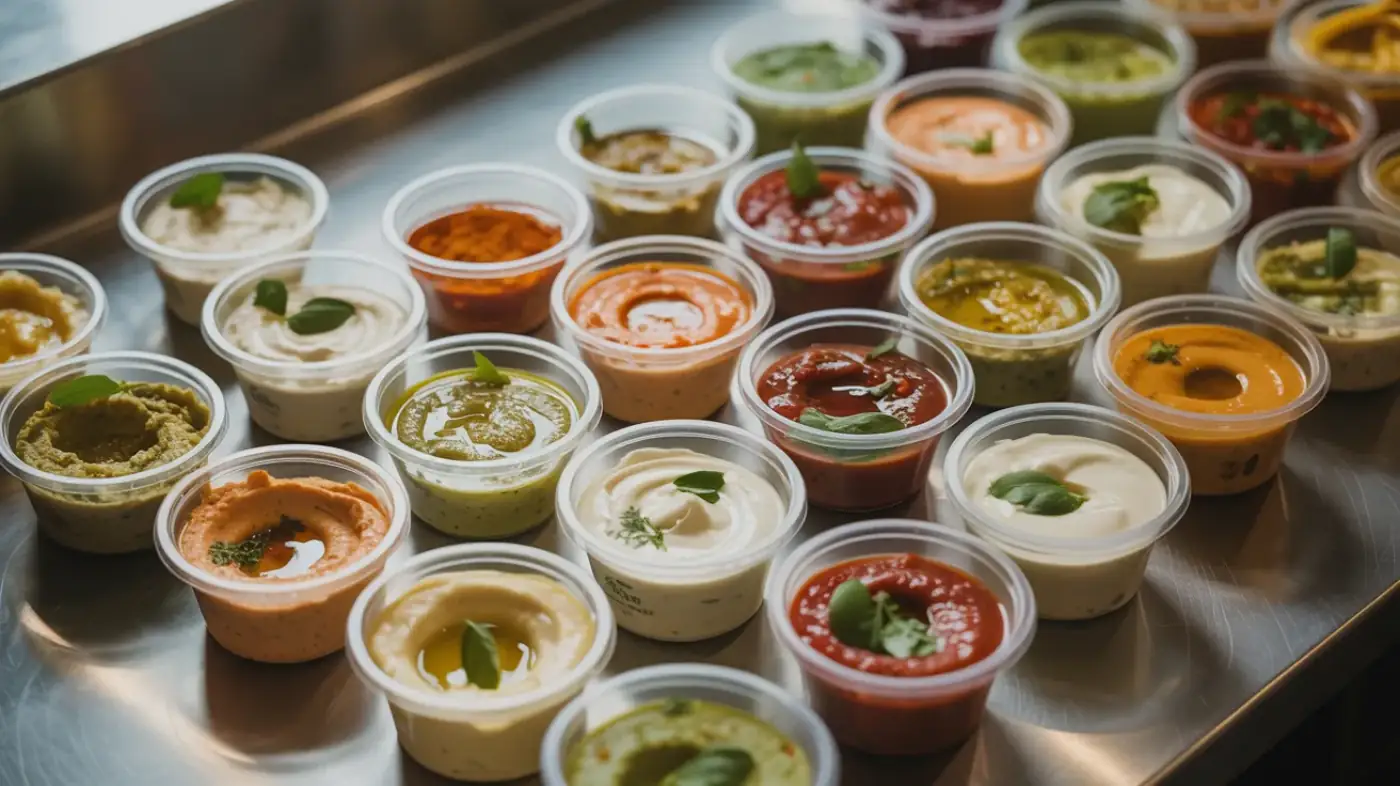
Hummus Cup Filling Machine & Cup Sealer
The SDH-R fills, seals, and caps hummus cups at up to 30 per minute with ±0.5% accuracy — a complete automatic hummus filling and sealing machine from $45,000 USD.
The Short Answer
The SDH-R is a hummus cup filling machine that denests, fills, seals and lids pre-formed cups in one rotary pass. A servo-driven piston dispenses 50 to 500 g at ±0.5%, wide-bore valving passes chunky hummus pieces, and a peristaltic pump can add an olive oil drizzle. Output reaches 30 cups per minute, 18 to 25 in production, with optional nitrogen MAP for longer refrigerated shelf life. Price starts at $45,000 USD.
- SpeedUp to 30 cups/min (18–25 in production)
- Fill range50–500 g at ±0.5% accuracy
- Cup sizes4–16 oz standard; 2–32 oz custom
- PriceFrom $45,000 USD
- Lead time8–12 weeks from order
- Built inCalgary, Canada · 12-month warranty
Specifications checked against SDH-R engineering dataEditorial policyCertifications & compliance
The SDH-R hummus cup filling machine is a fully automatic rotary system that fills, seals, and caps hummus cups in a single pass — engineered by Hummus Pack specifically for the world's fastest-growing dip category. If you're scaling from hand-filling or a semi-automatic line, this is the automatic hummus filling and sealing machine that turns packaging from a labour bottleneck into a consistent, retail-ready process at up to 30 cups per minute with ±0.5% accuracy.
Why the SDH-R Is the Right Hummus Filling Machine
All-in-One Fill, Seal & Cap
One compact rotary machine denests cups, fills hummus, applies a tamper-evident membrane seal, and adds an optional snap lid — no separate sealer or capper to buy or maintain.
Servo-Driven ±0.5% Accuracy
The volumetric piston filler meters by displaced volume, holding ±0.5% fill-weight accuracy across smooth, whipped, and chunky hummus — protecting net-weight compliance and margins.
MAP Nitrogen for Retail Shelf Life
Optional nitrogen flushing replaces headspace oxygen before sealing, extending refrigerated hummus shelf life from 7–10 days to 30–45+ days — the range grocery distribution demands.
Made in Canada, Fully Certified
Built from 304 stainless steel for CIP sanitation and HACCP/BRCGS facilities, the SDH-R ships with CE, FDA, and UL documentation and a 12-month warranty.
What Is a Hummus Cup Filling Machine?
A hummus cup filling machine is an integrated packaging cell that takes an empty cup off a stack and discharges a filled, sealed, retail-ready unit in one continuous cycle - no hand scooping, no bench-top lidding, no rework line behind it. On a rotary platform such as the SDH-R, every cup indexes through four stations on a single dial:
- Denest - a cup magazine releases one cup per index and seats it square in the dial pocket.
- Fill - a servo-driven volumetric piston deposits a measured shot of hummus, anywhere from 50 g to 500 g.
- Seal - a heated die bonds roll-film membrane (or a pre-cut lid) to the cup flange, forming a tamper-evident barrier.
- Lid & discharge - an optional snap-on overcap is pressed on and the finished cup leaves on the take-away conveyor.
The real dividing line between semi-automatic and fully automatic hummus filling equipment is where the operator sits inside that loop. Semi-automatic tabletop fillers still need a person to place each cup, trigger each shot and hand-load a separate sealer, which caps realistic output in the low single digits per minute and makes fill weight a function of operator fatigue. A fully automatic machine runs the entire sequence from one PLC recipe at up to 30 cups per minute on a dry cycle - typically 18-25 CPM in live production once product behaviour, film changes and short stops are counted - with one operator supervising rather than performing the cycle.
Hummus is a harder product to automate than it looks. It is a high-viscosity, shear-sensitive emulsion, so aggressive pumping collapses whipped textures and makes them weep. Chunky and rustic recipes carry whole chickpeas, pine nuts and diced pepper that bridge in narrow valves and skew a volumetric shot. Tahini and olive oil separate on standing, so an unagitated hopper fills oily at the top and dense at the bottom. And every cup carries a sealing flange that must stay spotless - one smear of tahini or oil on the rim is enough to fail the seal. Equipment designed for thin sauces tends to fail on all four counts, which is why hummus warrants purpose-built machinery. See the detailed hummus filling application notes or read how to automate hummus cup filling.
Hummus Filler Technology: Servo Volumetric Piston Dosing
Piston vs Pump vs Auger
Three dosing technologies compete for dip and spread work, and only one covers the whole hummus range. Auger fillers are built for free-flowing powders and handle heavy pastes poorly. Lobe and progressive-cavity pumps meter by rotation and time rather than by displaced volume, so any viscosity drift - a batch running two degrees warmer, a slightly wetter chickpea lot - shows up directly as weight drift, and continuous pumping keeps working an emulsion that whipped hummus needs left alone. A servo volumetric piston filler, the dosing system used on the SDH-R hummus filler, draws a fixed displaced volume into a cylinder and pushes it out through a large-bore valve. Volume defines the shot, not flow rate, which is why the same machine can run a silky classic recipe and a rustic chickpea-loaded one without re-engineering the dose.
Holding ±0.5% Across Smooth, Whipped and Chunky Textures
Accuracy of ±0.5% comes from control, not luck. The servo drive profiles piston velocity through the stroke - a slower draw so thick product fully charges the cylinder without cavitating, a controlled push so chunky product is displaced rather than forced, and a positive suck-back at the end of the stroke so the nozzle cuts clean instead of stringing tahini down the cup rim. Stroke length is set numerically in the recipe rather than by a mechanical stop, so a texture change is a parameter change. Large-bore valving and generous product paths let whole chickpeas and pine nuts pass without shearing or bridging.
What Give-Away Actually Costs
Do the arithmetic before dismissing accuracy as a spec-sheet detail. An 8 oz (227 g) cup overfilled by a conservative 2% gives away about 4.5 g per cup. At 20 CPM over an eight-hour shift - roughly 9,600 cups - that is about 43 kg of free hummus a shift. Tightening the target to a ±0.5% band lets you cut planned overfill to roughly a quarter of that, and the difference compounds every shift, every SKU, every week.
Up to Three Filling Stations in One Pass
Layered SKUs are where an automatic line pulls furthest ahead of hand work. The SDH-R supports up to three filler stations on the same dial, so a cup can receive its hummus base, an olive-oil drizzle and a paprika or pine-nut garnish in a single pass - no second line, no manual topping station, no double handling of an open cup. Each station carries its own recipe values, so a plain classic SKU and a garnished rustic SKU run on the same machine.
Hummus Sealing Machine and Hummus Cup Sealer Options
A hummus sealing machine does two jobs at once: it creates the oxygen and contamination barrier that shelf life depends on, and it produces the tamper evidence that grocery buyers require. On an integrated machine the hummus cup sealer is a station on the same dial as the filler, so the cup is sealed seconds after it is filled and never travels open.
Roll-Film Membrane Sealing (Tamper-Evident)
The workhorse format. Film feeds from a roll, is die-cut and heat-bonded to the cup flange in one action, and the bond is engineered so the membrane tears or delaminates visibly if anyone lifts it - that is the tamper evidence. Roll film is the lowest cost per unit at volume, carries printed branding, date coding and legal copy, and is the format nitrogen flushing is designed around.
Pre-Cut Lids
Optional pre-cut foil or film lids are picked and placed rather than die-cut from a web. They suit shorter runs, unusual cup geometries and operations that would rather stock lids per SKU than change film rolls, at a higher unit cost than roll stock.
Snap-On Lids and the Two-Barrier System
An optional snap-on overcap applied after the membrane gives the two-barrier build most retailers now expect: the sealed membrane protects the product and proves tamper evidence, while the rigid overcap protects the seal in transit, survives merchandising and lets the shopper reclose the cup at home. Foodservice and club packs almost always specify it; single-serve snack cups often do not.
Rim Cleanliness and Seal Integrity
Nearly every seal failure traces back to the flange. Oil, tahini or a chickpea fragment on the rim leaves a channel that the die cannot close, and a channel leak defeats MAP as surely as no seal at all. Controlled nozzle suck-back, an accurate shot that does not overshoot the cup, and sealing temperature, dwell and pressure held per SKU in the PLC recipe are what keep the flange clean and the bond consistent - with servo dosing keeping the fill away from the rim in the first place.
- What grocery expects: visible tamper evidence, a clean legible date code, consistent seal appearance cup to cup, no leakers in the case, and shelf life supported by your own validation data.
- What foodservice expects: a seal that survives stacking and transit, and a reclosable overcap for part-used packs.
The same sealing architecture runs across the wider dip filling and sealing machine range.
Hummus Shelf Life: MAP Nitrogen Flushing Before the Seal
Hummus is a high-moisture, fat-rich product, and three separate mechanisms shorten its life. First, surface mould and yeast, largely from airborne spores that settle on product while the cup sits open. Second, oxidation: the unsaturated fats in tahini and olive oil go rancid on contact with oxygen, producing the flat, painty, cardboard notes consumers reject long before anything is unsafe. Third, cosmetic decline - surface darkening and oil separation that make an in-date cup look old on shelf. All three are accelerated by the oxygen trapped in the headspace at the moment of sealing.
That is exactly what a MAP nitrogen flush targets. Immediately before the sealing die closes, a gas manifold floods the cup headspace with food-grade nitrogen, displacing the oxygen-bearing air, and the membrane is bonded at the same index so the low-oxygen atmosphere is locked in rather than allowed to re-equilibrate. Nothing is added to the recipe, no preservative declaration changes, and the product itself is untouched.
The practical gain is significant. Refrigerated hummus that would typically hold roughly 7-10 days without flushing can be extended to 30-45+ days refrigerated with MAP - the difference between a local direct-store-delivery radius and a national distribution footprint, and between weekly production runs and consolidated ones.
Three caveats belong in any honest conversation about it:
- MAP does not replace the cold chain. Those figures assume continuous refrigeration from your cooler to the retail case; a broken chain erases the benefit.
- The film has to be a genuine barrier. A high-permeability lidding film lets oxygen creep back over weeks, so specify barrier structure alongside the machine.
- MAP does not fix incoming microbial load. Batch sanitation, CIP discipline and clean flanges set the ceiling - flushing only protects what you sealed in.
Treat published ranges as a planning envelope and validate your own numbers with a lab shelf-life study on your recipe, film and cup. Our team can specify the MAP option against your target date code - talk to us about your shelf-life target.
Cup Sizes, Formats and Under-15-Minute Changeover
Hummus sells in more formats than almost any other chilled dip, and a filling line that cannot follow those formats becomes the ceiling on the business. The SDH-R runs standard 4, 8, 10 and 16 oz cups with custom tooling from 2 oz to 32 oz, and fill weights from 50 g to 500 g, which covers essentially the whole category:
- 2-4 oz single-serve - snack and grab-and-go cups, lunch-kit components, catering, in-flight and hotel amenity packs, and cross-merchandised pairings with pretzels or veg sticks.
- 8-10 oz retail - the grocery mainstay, and the size where fill accuracy and seal appearance are judged hardest on shelf.
- 16-32 oz club and foodservice - warehouse club multipacks, deli tubs and restaurant back-of-house packs.
Most hummus producers are not running one SKU but a matrix: classic, roasted garlic, roasted red pepper, jalapeño, lemon herb, organic, whipped, black bean, edamame, beet and chunky rustic with whole chickpeas - each in two or three cup sizes. That means changeover, not top speed, is what actually governs weekly output. Flavour changeover runs under about 15 minutes on the SDH-R because the two slow parts of the job have been engineered out: fill volume, seal temperature, dwell and index timing are stored per SKU in the PLC/HMI and recalled as a recipe rather than dialled in by hand, and the product-contact path strips down tool-free for wash-down, so a hopper, piston and valve change does not need a fitter or a toolbox.
Hygiene is part of that same calculation. The machine is 304 stainless steel with CIP, which matters for allergen control as much as for microbiology: sesame is a declared major allergen in both the United States and Canada, and any pine-nut garnish adds a tree-nut claim, so a validated wash between a garnished SKU and an organic or allergen-restricted SKU is non-negotiable. Planning a multi-SKU build-out is covered in depth in scaling a hummus production line.
Hummus Filling Machine Price and What to Expect When You Buy
The SDH-R starts from $45,000 USD. Buyers researching hummus filling machine price should read that as a configured base rather than a fixed number, because the same platform can be specified thin or fully loaded. The main cost drivers are:
- Number of filler stations - a single base filler versus up to three for base, olive-oil drizzle and garnish in one pass.
- MAP nitrogen flush - the gas manifold and controls that take you from a 7-10 day date code to 30-45+ days refrigerated.
- Sealing format - roll-film membrane, pre-cut lid pick-and-place, and an optional snap-on lid applicator.
- Change parts and tooling - one set per cup diameter and depth; a four-size SKU matrix costs more in tooling than a single-size line.
- Downstream integration - labelling, date coding and take-away conveyors.
Included as standard: the fully automatic rotary machine in 304 stainless with CIP and tool-free strip-down, servo volumetric dosing at ±0.5%, PLC/HMI recipe storage, CE, FDA and UL compliance, and a 12-month warranty. The footprint is compact at 44 x 52 in and 65.6 in high, so it fits an existing chilled room rather than forcing a building decision. Machines are built in Calgary, Alberta, with delivery in 8-12 weeks and service centres in Alberta, New Jersey and California - a real consideration when your alternative is an overseas supplier and a six-week parts wait.
Installation and operator training are part of commissioning, not an afterthought, and the payback case is usually built from three levers: the hand-filling labour the machine displaces, the give-away it eliminates through accurate dosing, and the distribution reach MAP unlocks in a North American hummus market worth roughly $2.68B in 2026 and growing about 8.1% a year to $3.67B by 2032. For a line-by-line breakdown see our guide to cup filling and sealing machine cost, or request a configured quote with your cup sizes, target CPM and shelf-life goal.
SDH-R Hummus Filling Machine — Full Specifications
Every specification for the SDH-R automatic hummus cup filling and sealing machine.
| Specification | SDH-R |
|---|---|
| Throughput | Up to 30 cups per minute (dry cycle) |
| Real-world output | 18–25 cups/min depending on product, cup size & options |
| Fill range | 50 g – 500 g (2 oz – 17 oz) |
| Fill-weight accuracy | ±0.5% (servo-driven volumetric piston) |
| Standard cup sizes | 4 oz, 8 oz, 10 oz, 16 oz |
| Custom cup sizes | 2 oz – 32 oz with matching tooling |
| Cup shapes | Round, square, rectangular |
| Sealing | Roll-film membrane heat seal (tamper-evident) |
| Lidding options | Pre-cut lid · snap-on lid (pick-and-place) |
| Shelf-life option | MAP nitrogen flush — 7–10 days to 30–45+ days refrigerated |
| Filler stations | Up to 3 (base + drizzle + garnish in one pass) |
| Construction | 304 stainless steel |
| Cleaning | CIP clean-in-place + tool-free strip-down |
| Controls | PLC + HMI with recipe storage & diagnostic alerts |
| Changeover | Under ~15 minutes between SKUs |
| Certifications | CE, FDA, UL |
| Footprint | 44 × 52 in (1,100.5 × 1,315.5 mm) |
| Height | 65.6 in |
| Origin | Made in Canada (Calgary, Alberta) |
| Warranty | 12 months |
| Delivery | 8–12 weeks from order confirmation |
| Starting price | From $45,000 USD |
Manual vs Semi-Automatic vs Automatic Rotary Cup Filling
Which tier of cup filling machine fits your production stage (throughput varies by product, cup size and fill weight).
| Factor | Hand-filling | Semi-automatic / tabletop | SDH-R automatic rotary |
|---|---|---|---|
| Typical output | ~3–6 cups/min | ~8–15 cups/min | Up to 30 cups/min |
| Operators on fill & seal | 3–5 | 1–2 | 1 supervising |
| Fill-weight accuracy | Operator-dependent | Moderate | ±0.5% servo volumetric |
| Cup denesting | Manual | Manual | Automatic pneumatic denester |
| Tamper-evident sealing | Hand-applied lids | Separate bench sealer | Integrated membrane seal |
| Multi-component fills | Manual second pass | Not typical | Up to 3 filler stations, one pass |
| MAP / extended shelf life | Not available | Rarely available | Optional nitrogen flush (30–45+ days) |
| Typical investment | Lowest | Moderate | From $45,000 USD |
| Best fit | Recipe development, markets | Local retail, short runs | Regional & national retail supply |
The SDH-R Hummus Filling Machine
Hummus Products It Fills
Available In These Markets
How the SDH-R Fills & Seals Hummus
From empty cup to sealed, retail-ready hummus — fully automatic, no manual labour
Cup Denesting
Empty cups are automatically separated from a nested stack and placed into the rotary table carriers. The pneumatic denester handles round, square, and rectangular cups from 2oz to 32oz.
Servo-Driven Filling
The volumetric piston filler draws a precise dose and dispenses it into the cup. Servo control adjusts stroke length and speed per recipe, maintaining ±0.5% fill-weight accuracy. The PLC stores recipes for quick changeovers.
Membrane Heat Sealing
Roll-stock film is drawn across the filled cup and heat-sealed to create a tamper-evident, airtight membrane. Sealing temperature, pressure, and dwell time are individually controlled to match your film and cup materials.
Snap-On Lid (Optional)
A pick-and-place mechanism applies a consumer-friendly snap-on lid over the membrane seal — a two-barrier system providing tamper evidence and reclosability for grocery retail and foodservice.
MAP Nitrogen Flush (Optional)
Modified Atmosphere Packaging replaces headspace oxygen with food-grade nitrogen immediately before sealing, typically extending refrigerated shelf life from 7–10 days to 30–45+ days.
Hummus Filling Machine — Frequently Asked Questions
The SDH-R hummus filling machine starts at $45,000 USD for the single-filler configuration. Final price depends on the number of filler stations (up to three), MAP nitrogen flushing, sealing and lidding format, custom cup tooling, and downstream integration. Contact us for a quote scoped to your products and volume.
The SDH-R fills up to 30 cups per minute in dry-cycle operation. Real-world throughput for hummus typically runs 18–25 cups per minute depending on cup size, fill weight, sealing method, and whether MAP nitrogen flushing is enabled.
Yes. The SDH-R is an all-in-one automatic hummus filling and sealing machine — it denests the cup, fills it with a servo-driven volumetric piston, applies a tamper-evident roll-film membrane seal, and can add an optional snap-on lid, all in one automatic rotary pass.
The servo-driven volumetric piston filler holds ±0.5% fill-weight accuracy across classic, whipped, and chunky hummus textures. Consistent fills protect net-weight compliance and cut the product give-away that overfilling causes.
Yes. Large-bore valving and generous product paths let whole chickpeas, pine nuts, and diced peppers pass without shearing or bridging, and the servo piston meters by displaced volume so particulates do not upset fill weight.
Under about 15 minutes. Fill volume, seal temperature, dwell, and index timing are stored per SKU in the PLC/HMI and recalled as a recipe, and the product-contact path strips down tool-free for wash-down between flavours.
Standard delivery is typically 8–12 weeks from order confirmation, depending on configuration. Every SDH-R is made in Canada, ships with CE, FDA, and UL documentation, and includes a 12-month warranty with service centres in Alberta, New Jersey, and California.
Related Machines & Guides
Ready to Buy a Hummus Filling Machine?
Get a personalized SDH-R quote for your hummus products, cup sizes, and production volume.