
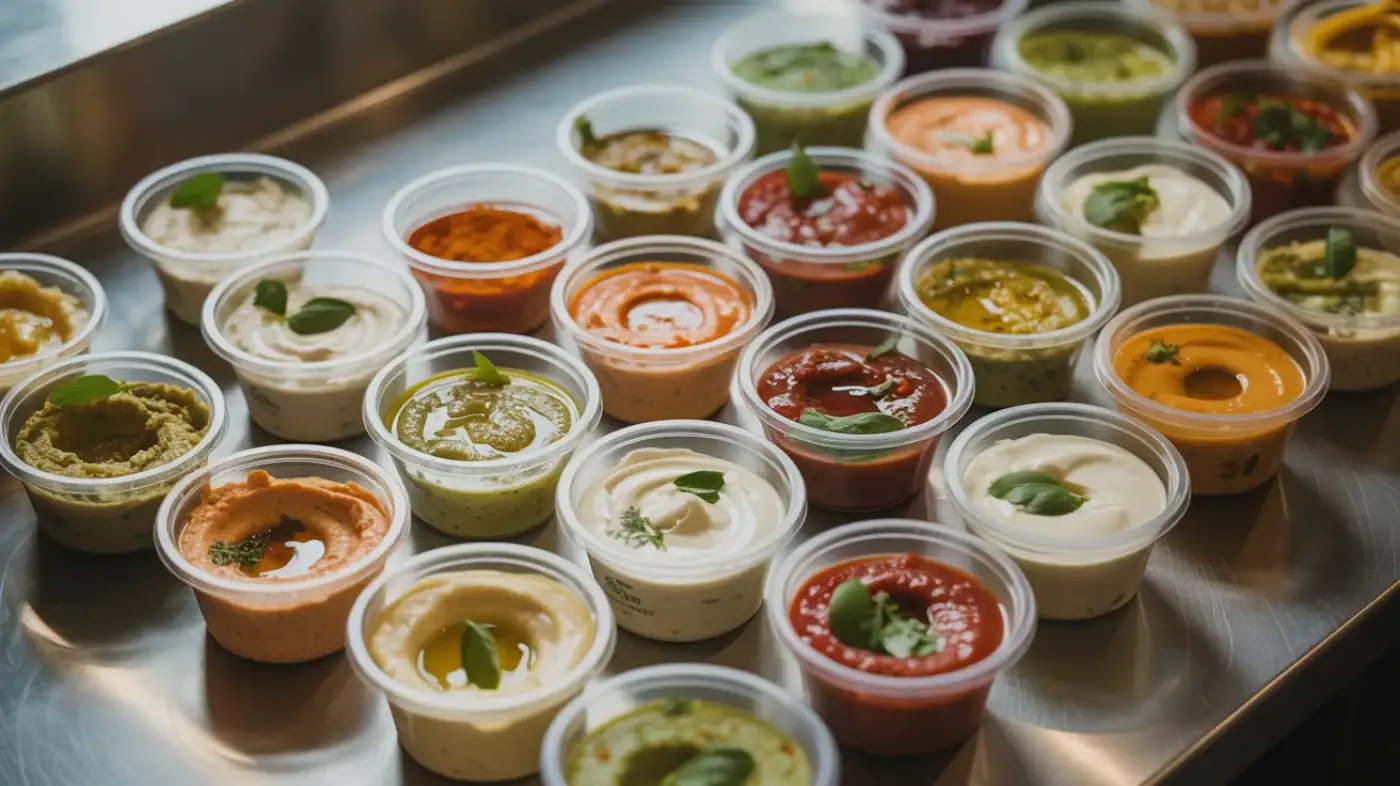
Salad Filling Machine for Deli Salad Cups and Tubs
Fill, seal and lid potato, macaroni, egg, chicken and grain salads in pre-formed cups and tubs. The SDH-R runs up to 30 cups per minute with ±0.5% servo piston accuracy and wide-bore valving for chunky, dressed products.
A salad filling machine portions prepared salad into pre-formed cups or tubs, then seals and lids them. The Hummus Pack SDH-R is a rotary salad filling machine for chunky, dressed deli salads such as potato, macaroni, egg and grain salads. It runs up to 30 cups per minute (18–25 real-world), fills 50–500 g with ±0.5% servo piston accuracy, and adds dressing or garnish in one pass. Leafy salads in clamshells are not a fit.
- Output
- Up to 30 cups/min (18–25 real-world)
- Fill range
- 50 g – 500 g (approx. 2 oz – 17 oz)
- Fill accuracy
- ±0.5% (servo-driven volumetric piston, base fill)
- Cup sizes
- Standard 4, 8, 10, 16 oz; custom 2–32 oz with matching tooling
- Fillers per pass
- Up to 3 (base salad, dressing, garnish)
- Price
- From $45,000 USD (single-filler configuration)
- Lead time and warranty
- 8–12 weeks from order confirmation; 12-month warranty
What Is a Salad Filling Machine for Prepared Deli Salads?
A salad filling machine portions a prepared, dressed salad into a pre-formed cup or tub, then seals and lids it. Prepared salads are harder to fill than dips because they carry pieces: diced potato, pasta, chopped egg, shredded cabbage, grains and herbs. Pieces jam valves, smear sealing flanges and make fill weights drift, so the filler, nozzle and sealing station must be chosen for the product.
The Hummus Pack SDH-R is a fully automatic rotary cup filling machine designed and built in Calgary, Alberta. As a deli salad filling machine it pairs a servo-driven volumetric piston filler and wide-bore valving with optional garnish and dressing stations, a roll-film heat seal and optional nitrogen flushing.
Which Salads Run on a Prepared Salad Filling Machine
As a prepared salad filling machine, the SDH-R targets fresh, refrigerated salads that can be filled into cups at a pumpable temperature:
- Potato salad in mayonnaise, mustard or vinaigrette dressings
- Macaroni, pasta and other pasta-based salads
- Egg salad, chicken salad and tuna salad
- Coleslaw and other shredded-vegetable salads
- Grain salads, including quinoa, couscous and tabbouleh
Fill temperature, unusual viscosity and very large pieces are confirmed with our engineering team before we quote.
Salads that are not a fit
Leafy green salads in clamshells and bowls are not a fit for any cup-based salad filling machine. They are dry, bulky and fragile, and they are packed by weight into clamshells, which is a different machine category; our guide to types of food packaging machines explains the split. The SDH-R also does not handle shelf-stable (aseptic or retort) or frozen salads, and a single-SKU line above 30 cups per minute suits an inline format better (see rotary versus inline).
Salad Cup Filling Machine Setup by Salad Type
The table shows how we usually set up the SDH-R as a salad cup filling machine for each salad type. Piece size and dressing viscosity change the details, so treat it as a starting point, not a guarantee.
Salad type versus SDH-R setup (starting points, confirmed per recipe)
| Salad type | Typical setup | What we check before quoting |
|---|---|---|
| Potato salad | Piston base fill, wide-bore valving, suck-back nozzle | Cube size, softness, dressing viscosity |
| Macaroni and pasta salad | Piston base fill, wide-bore valving | Pasta shape and size, dressing absorption |
| Egg salad | Piston base fill, cut-off or suck-back nozzle | Chop size, dressing ratio |
| Chicken and tuna salad | Piston base fill, wide-bore valving | Largest piece size; FDA or USDA FSIS oversight |
| Coleslaw | Piston base fill; optional peristaltic dressing | Shred length, weeping in the cup |
| Grain and quinoa salad | Piston base fill; garnish filler; peristaltic oil or dressing | Grain texture, dressing separation |
| Tabbouleh | Piston base fill (herbs pass wide-bore valving); peristaltic oil-lemon dressing | Herb cut size, free liquid |
| Leafy salad in a clamshell | Not a fit | Weigh-and-pack clamshell line instead |
Particulates and Fill-Weight Consistency in Chunky Salads
This salad filling machine fills with a servo-driven volumetric piston that delivers ±0.5% fill-weight accuracy on the base component. Volumetric means the piston dispenses a set volume, so weight consistency also depends on the salad holding a steady density. In a smooth dip that is easy; in a salad, density moves with how pieces pack and how much air sits between them.
A potato salad filling machine faces the hardest version of this problem: soft cubes that damage easily and dressing that drains toward the bottom of the feed. Four habits keep chunky salads consistent:
- Keep the salad mixed and the feed steady, because drained dressing changes density from cup to cup.
- Match valve bore to piece size. Wide-bore valving passes particulates such as herbs, shredded cucumber and nut pieces; larger pieces are confirmed with engineering first.
- Choose the nozzle for the product: cut-off for cohesive salads, suck-back for drip-free fills that keep dressing off the sealing flange.
- Add the optional weight checker, which feeds finished-cup weights back to the filler.
Garnish is different. A garnish filler dosing nuts, seeds, herbs or chunky toppings delivers discrete pieces, so its weight varies more than the piston base. We say so rather than quote one accuracy figure for the whole cup.
Get a configured SDH-R quote for your productSend your product, cup size and target cups per minute — we reply within 24 hours.
Request a quoteDressing, Garnish and Multi-Component Salad Filling
Many producers dress and mix in the blender and fill one component, which a single base filler handles. The alternative is to treat dressing and toppings as separate components. As a salad filling machine, the SDH-R supports up to three fillers in one pass:
- Base salad: servo-driven volumetric piston filler (standard).
- Dressing and oil: optional peristaltic pump for oil, dressings and sauces.
- Garnish: optional filler for nuts, seeds, herbs and chunky toppings.
- Powders: optional vibration filler for spice blends.
Separating dressing helps when it is thin or oily, when crunchy elements would soften, or when one base should feed several flavors; HMI recipe storage and SKU changeovers under about 15 minutes keep that practical. The trade-off is that dressing added in the cup is not mixed. That works for grain, bean and vegetable salads, but emulsified potato or egg salad should still be dressed in the mixer. Our article on piston versus pump fillers explains the dressing pump choice.
Sealing and MAP for Refrigerated Salad Freshness
The SDH-R seals with film cut from a roll, giving a heat-sealed, tamper-evident membrane; a plastic lid can be added by pick-and-place or a snapping device. In chunky salad, seal quality depends on a clean flange. A piece of pasta or a smear of dressing on the rim is the usual cause of a weak seal. Seal temperature, pressure and dwell time are the parameters to validate for each film and cup.
An optional nitrogen flush reduces residual oxygen in the container to 0.3–0.4%. In our refrigerated dip applications, MAP typically stretches shelf life from roughly 7–10 days to 30–45+ days, depending on the product. We do not publish a figure for salads: shelf life in mayonnaise- or egg-based salad is set by formulation, acidity, preservatives, cold chain and plant hygiene, and your own lab or process authority must validate it. Our nitrogen flushing guide covers the mechanics.
Listeria Control and Sanitary Design for Ready-to-Eat Salad Plants
Ready-to-eat salads are not cooked after packaging and are stored cold, and Listeria monocytogenes can grow at refrigeration temperatures. Under the FDA's Preventive Controls for Human Food rule (21 CFR Part 117) and Canada's Safe Food for Canadians Regulations, the plant owns that hazard analysis, including environmental monitoring and sanitation controls. Salads containing meat or poultry can fall under USDA FSIS rather than FDA oversight, so confirm which agency applies.
No machine makes a plant Listeria-free. A deli salad filling machine can avoid creating harborage and make cleaning fast enough that it actually happens:
- Food-grade 304 stainless steel construction.
- Tool-free strip-down for cleaning, plus an optional clean-in-place (CIP) system.
- Drip-free suck-back nozzles that keep dressing off cup flanges and surrounding surfaces.
- A sealed, tamper-evident roll-film closure on every cup.
Allergen control matters as much. Egg, fish (tuna), wheat (macaroni), milk, tree nuts and sesame are common in deli salads, and sesame became the ninth major US allergen on January 1, 2023 under the FASTER Act; our food labeling requirements guide covers the declaration basics. The SDH-R is designed to support plants operating under HACCP, BRCGS or SQF programs; the machine itself is not certified to those schemes. Our certifications and compliance page lists what it does carry: CE, FDA-compliant food-contact materials and UL listing.
How the SDH-R Fills, Seals and Lids a Salad Cup
A salad container filling machine must do several jobs in order. In the SDH-R each cup passes through one indexing rotary turret:
- Cup loading and denesting by a pneumatic denester.
- Base filling by the servo volumetric piston.
- Secondary and third filling (optional): dressing, garnish or powders.
- Roll-film membrane sealing.
- Nitrogen MAP flushing (optional).
- Plastic lid placement (optional), then discharge to the conveyor.
Output is up to 30 cups per minute on a dry cycle and 18–25 in real-world production, depending on product, cup size, fill weight and options.
Deli Salad Filling Machine Specifications and Price
SDH-R specifications relevant to salad packing
| Specification | SDH-R |
|---|---|
| Machine type | Fully automatic rotary cup filling, sealing and lidding |
| Output | Up to 30 cups/min dry cycle; 18–25 real-world |
| Fill range | 50–500 g (approx. 2–17 oz) |
| Fill accuracy | ±0.5% (servo volumetric piston base fill) |
| Cup sizes | Standard 4, 8, 10, 16 oz; custom 2–32 oz |
| Fillers | Up to 3 per pass: piston, vibration, garnish, peristaltic pump, or custom |
| Closing | Roll-film seal, pre-die-cut lids, plastic lid, snap-on device |
| Footprint | 44 × 52 in, height 65.6 in |
| Certifications | CE, FDA compliant, UL listed |
Pricing starts from $45,000 USD for the single-filler configuration. A salad filling machine build with a peristaltic dressing pump, garnish filler, nitrogen MAP or labeling is a multi-option configuration and priced above that, as is custom tooling. Our cup filling and sealing machine cost guide explains what drives price, and you can request a quote for your salad.
Two limits to plan around: fills below 50 g are outside the standard range, and the 500 g ceiling means a 1 lb (454 g) net weight fits while a 2 lb (about 907 g) deli tub does not.
Request a Quote for a Salad Filling Machine in the USA and Canada
We design and build the SDH-R in Calgary, Alberta, and support plants across the United States and Canada from service centres in Alberta, New Jersey and California. Delivery is 8–12 weeks from order confirmation, with a 12-month warranty; the SDH-R product page has the full overview. To quote your salad filling machine accurately, send us:
- The salads you pack and a typical recipe.
- Largest piece size, cut specification and dressing type.
- Cup or tub size, shape and target net weight.
- Target cups per minute.
- Options: second or third filler, nitrogen MAP, plastic lids, labeling, weight checker or CIP.
Use the contact page, email sales@hummuspack.com or call +1 (888) 922-7271, Monday to Friday, 9:00 AM to 5:00 PM MDT. Our team may reach out to learn about your application first, and we reply within about 24 hours.
Salad Filling Machine — Frequently Asked Questions
An automatic rotary cup filling, sealing and lidding machine with a volumetric piston filler and wide-bore valving. The Hummus Pack SDH-R fills 50–500 g into pre-formed cups and tubs at up to 30 cups per minute (18–25 real-world), then heat-seals with roll film and adds an optional lid. Piece size and dressing viscosity are confirmed before quoting.
No. The SDH-R fills pre-formed cups and tubs with salads that can be portioned volumetrically, such as potato, pasta, egg, chicken, grain and shredded coleslaw. Leafy greens in clamshells are bulky, dry and fragile and run on a different type of line. We would rather say so up front than sell a mismatched machine.
The SDH-R salad filling machine runs up to 30 cups per minute on a dry cycle and 18–25 cups per minute in real-world production, depending on product, cup size, fill weight and options. Chunky, multi-component salads sit toward the conservative end. A single-SKU line above 30 cups per minute needs an inline format instead.
The servo-driven volumetric piston base fill delivers ±0.5% fill-weight accuracy. Because the piston dispenses volume, weight consistency also depends on uniform salad density. A garnish filler dosing nuts, seeds or herbs varies more than the piston base, and an optional weight checker with a feedback loop verifies finished cups.
Yes. The SDH-R supports up to three fillers in one pass: the salad base through the volumetric piston, dressing, oil or sauce through an optional peristaltic pump, and nuts, seeds or herbs through an optional garnish filler. This suits grain, bean and vegetable salads. Emulsified potato or egg salad is normally dressed in the mixer first.
Nitrogen flushing reduces residual oxygen in the cup to 0.3–0.4%. In our refrigerated dip applications it typically extends shelf life from roughly 7–10 days to 30–45+ days, depending on the product. Salad results depend on formulation, acidity, preservatives and cold-chain control, so validate shelf life with your own lab. MAP is not a Listeria control.
A salad filling machine built on the SDH-R starts from $45,000 USD for the single-filler configuration. A peristaltic dressing pump, garnish filler, nitrogen MAP, labeling or custom tooling adds to that. Delivery is 8–12 weeks from order confirmation, with a 12-month warranty. Contact us with your salad, cup size and target cups per minute.
The SDH-R is built from food-grade 304 stainless steel with tool-free strip-down, and an optional clean-in-place system is available. SKU changeovers with stored HMI recipes take under about 15 minutes. Your allergen and sanitation program defines the wash steps between egg, fish, wheat, tree nut or sesame salads.
Standard cup sizes are 4, 8, 10 and 16 oz, with custom sizes from 2 to 32 oz using matching tooling, in round, square or rectangular formats. Fill weights run 50–500 g (about 2–17 oz), so a 1 lb (454 g) net weight fits. A 2 lb tub is outside the standard range, and fills under 50 g are not standard.
Related machines & guides
Explore the pages most relevant to this application.
Why producers buy from Hummus Pack
Ready to Quote Your Salad Filling Machine?
Get a personalized SDH-R configuration and price for your product, cup sizes, and production volume.