
Semi Automatic Cup Filling Machine: When to Move Up to Full Automation
Compare manual, semi-automatic and fully automatic cup filling, then work out your own payback. Our Calgary-built SDH-R fills up to 30 cups per minute at ±0.5% accuracy; this guide shows when semi-automatic is still enough.
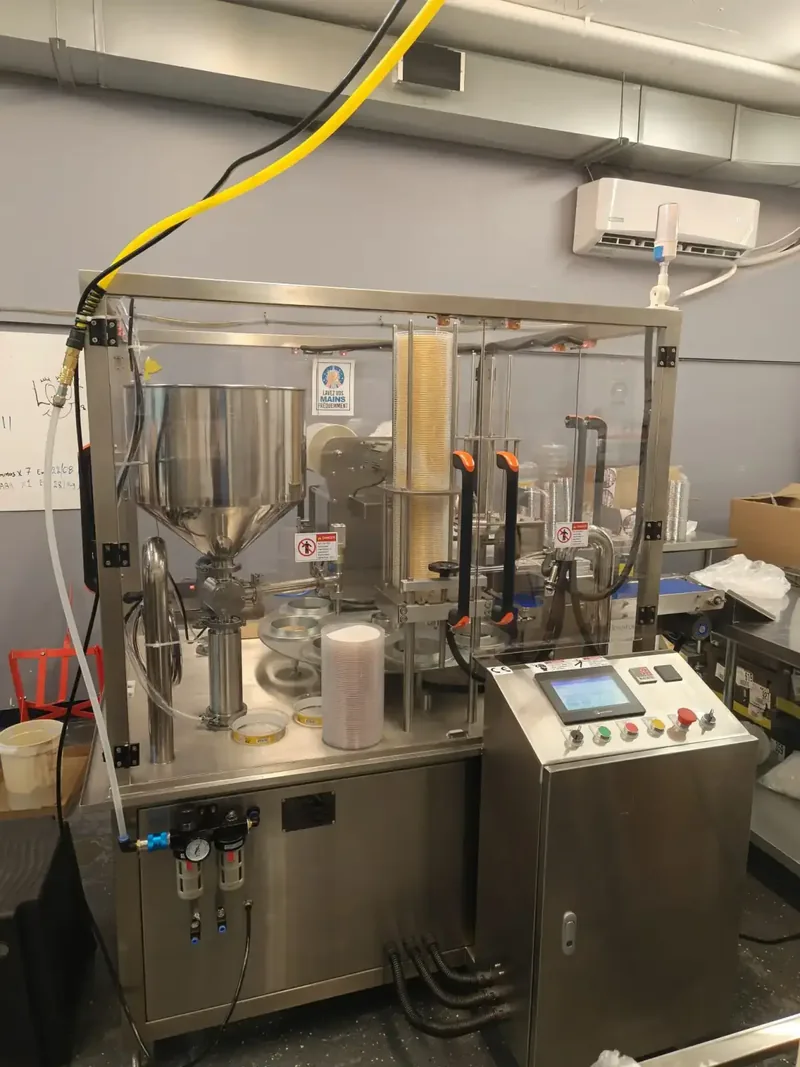
A semi automatic cup filling machine is a powered filler where an operator places each cup, triggers the fill and carries the cup to a separate sealer. Hummus Pack does not sell one. Our fully automatic SDH-R rotary machine denests, fills, seals and lids cups at up to 30 cups per minute (18–25 real-world) with ±0.5% accuracy, from $45,000 USD, and pays off when labour, giveaway or seal consistency limits growth.
- Machine
- SDH-R fully automatic rotary cup filling, sealing and lidding machine
- Output
- Up to 30 cups/min dry cycle (18–25 real-world)
- Fill accuracy
- ±0.5% (servo-driven volumetric piston)
- Fill range
- 50 g – 500 g (approx. 2 oz – 17 oz)
- Price
- From $45,000 USD (single-filler configuration)
- Lead time and warranty
- 8–12 weeks from order confirmation; 12-month warranty
- Built in
- Calgary, Alberta, Canada; service centres in Alberta, New Jersey and California
What Is a Semi Automatic Cup Filling Machine?
A semi automatic cup filling machine is a powered filler that still depends on an operator for part of every cycle. The operator places an empty cup under the nozzle, triggers the fill with a foot pedal or push button, and then moves the filled cup to a separate sealer or lidding step. The machine controls the dose; a person controls the sequence.
To be plain about it, Hummus Pack does not sell a semi-automatic machine. We build one machine, the SDH-R, a fully automatic rotary cup filling, sealing and lidding machine designed and built in Calgary, Alberta. This guide shows where a semi-automatic filler is the better purchase.
Manual, semi-automatic and fully automatic: the three levels
- Manual: People place, fill, wipe, seal and box every cup, usually with a hand-operated dosing head. Lowest capital cost, greatest dependence on operator skill.
- Semi-automatic: A powered piston or pump doses a set amount when the operator triggers it. People load and unload cups, and sealing is a separate bench sealer or hand step.
- Fully automatic: Cups are denested, indexed, filled, sealed, optionally gas-flushed and lidded, then discharged without handling. People supervise and pack out. The SDH-R belongs here.
Manual vs Automatic Cup Filling Machine: Side-by-Side
The table compares the three levels. Manual and semi-automatic throughput figures are illustrative ranges that vary by machine, product and operator. They are not Hummus Pack specifications.
Manual vs semi-automatic vs SDH-R fully automatic cup filling (manual and semi-automatic throughput illustrative only)
| Factor | Manual | Semi-automatic | SDH-R fully automatic |
|---|---|---|---|
| Cup handling | Operator, every cup | Operator, every cup | Pneumatic denester; conveyor discharge |
| Dosing | Hand-operated; varies by operator | Powered dosing triggered per cup | Servo-driven volumetric piston, ±0.5% |
| Sealing | Separate hand or bench step | Separate bench sealer, cups moved by hand | Roll-film heat seal in the same pass; optional plastic lid |
| Throughput | Operator-paced, often a few cups/min (illustrative) | Roughly 8–15 cups/min per operator (illustrative) | Up to 30 CPM dry cycle; 18–25 CPM real-world |
| Labour per cup | Highest | High: separate people to fill, seal and pack | Lowest: operators supervise, replenish and pack out |
| Hygiene exposure | Hands and open product throughout | Hands near open cups between fill and seal | Hands-off from loading to sealed discharge; optional CIP |
| Capital cost | Lowest | Low to moderate | From $45,000 USD (single filler) |
Semi-automatic mechanizes the dosing. Fully automatic also mechanizes cup handling, sealing, lidding and discharge, which is where most labour, hygiene and seal-quality differences appear.
Labour and Throughput: What a Semi Automatic Cup Filling Machine Really Costs
In a semi-automatic line, output is set by the slowest human step, and that is rarely the filler. One person loads and triggers, another seals, another wipes and packs. To go faster you add people, so labour cost per cup stays roughly flat as volume grows.
A rotary cup filling machine indexes cups through every station in one pass, so the machine cycle sets output. The SDH-R runs up to 30 cups per minute on a dry cycle and 18–25 in real-world production, depending on product, cup size, fill weight and options: 1,080 to 1,500 cups per hour. Operators still replenish cups and film and pack out, but those tasks do not scale cup for cup. See scaling a hummus production line.
Fill Consistency and Giveaway: Semi-Automatic vs ±0.5% Servo Filling
A well-maintained semi-automatic piston filler can dose consistently from stroke to stroke. Variation usually comes from the process around it: cup position, nozzle dwell, product temperature and viscosity drifting during a run, and drips landing on the flange. Those are harder to control when a person is part of the cycle.
The SDH-R uses a servo-driven volumetric piston filler with ±0.5% fill-weight accuracy across 50 g to 500 g (roughly 2 oz to 17 oz). Suck-back nozzles give drip-free cut-off, and wide-bore valving passes particulates such as herbs and nut pieces. See the benefits of servo-driven filling machines.
Accuracy matters in dollars because you cannot fill below declared net content, so plants set targets above the label claim and everything above it is given away. A tighter tolerance lets the target sit closer to the label. Check labeling requirements for dips and spreads with your compliance adviser.
Get a configured SDH-R quote for your productSend your product, cup size and target cups per minute — we reply within 24 hours.
Request a quoteSemi Automatic Cup Filling and Sealing Machine Setups: Hygiene and Seal Quality
A semi automatic cup filling and sealing machine setup usually means a filler and a separate sealer with hands in between. Cups sit open, rims are handled, and the gap between fill and seal depends on how busy the operator is. Product also lands on the flange more often, and a contaminated flange can compromise the seal.
Seal quality rests on temperature, pressure and dwell time. Hand-cycled sealers vary in dwell and placement from cup to cup. The SDH-R makes a tamper-evident roll-film heat seal in the same indexed cycle as filling, with pre-die-cut lids, plastic lid pick-and-place and snap-on devices as alternatives.
For plants under FSMA preventive controls (21 CFR Part 117), HACCP, BRCGS or SQF, fewer touchpoints means fewer hazards to control and document. The SDH-R uses food-grade 304 stainless steel, tool-free strip-down and optional CIP, and is designed to support plants operating under those programs; the machine itself is not certified to them. It carries CE and UL listing and uses FDA-compliant food-contact materials (see certifications and compliance).
Optional nitrogen flushing reduces residual oxygen to 0.3–0.4%, and refrigerated shelf life can extend from roughly 7–10 days to 30–45+ days, depending on the product. That is hard to repeat when cups are carried by hand; see MAP nitrogen flushing and dip shelf life.
When a Semi Automatic Cup Filling Machine Is Enough
Automation is not always the answer. A semi-automatic cup filler is a sensible, lower-risk purchase when most of these are true:
- You fill a modest number of cups per week and labour is not what limits sales.
- You are still developing the product, cup or market (pilot batches, farmers markets, a first retail listing).
- You run many cup formats at small volumes per SKU, so set-up time matters more than speed.
- Your cups are below the SDH-R standard range, such as 1 oz tasting cups (under 50 g).
When to Automate Cup Filling: Signals That Point to the SDH-R
Plants usually automate because of a specific pain, not a wish to modernize. Common signals:
- You decline or delay orders because the fill and seal room is at capacity.
- Overtime or temporary labour regularly covers fill, seal and pack.
- Fill weights drift between shifts, or checkweigher data shows measurable giveaway.
- Seal failures, leakers or lid complaints reach you from retailers.
- Customers or auditors want fewer manual touchpoints, or shelf life limits how far you can ship.
If two or three apply, request a quote and we will size an SDH-R configuration against your product, cup and target rate.
When the SDH-R is not the right step
The SDH-R targets fresh and refrigerated cups filled at a pumpable temperature. It is not aseptic, not a retort system, not a tray sealer for meat or poultry, and not for frozen products. If you need well over 30 cups per minute on one SKU, an inline cup filling machine fits better; see rotary vs inline filling machines. We confirm fill temperature, viscosity extremes and unusual particulates before quoting.
ROI for Automating Cup Filling: A Simple Payback Formula
Use your own measured numbers in these six steps, and we give no benchmark figures because the inputs are specific to your plant. Weigh filled cups at several points in a shift to find true overfill, and time your crew over a full shift for labour hours per 1,000 cups.
- Labour saving = (labour hours per 1,000 cups today minus after automation) × loaded hourly wage × cups per year ÷ 1,000.
- Giveaway saving = cups per year × target fill weight (kg) × (current average overfill minus the overfill you can hold at ±0.5%, as decimals) × product cost per kg.
- Scrap saving = fewer rejected cups (bad seals, flange contamination, weight rejects) × cost of product, cup and film.
- Added running cost = film, lids, nitrogen if used, maintenance, utilities and training.
- Annual net benefit = steps 1 + 2 + 3 minus step 4, plus margin on orders you can now accept.
- Simple payback (years) = installed machine cost ÷ annual net benefit.
Illustrative arithmetic only, with round numbers not drawn from any customer: 1,000,000 cups a year at 227 g (8 oz), product at $3.00 per kg, current overfill 2.0%, new overfill 0.5%. Giveaway saving = 1,000,000 × 0.227 × 0.015 × $3.00 = $10,215 per year. Labour can be a larger line, so step 1 often decides the answer.
Machine pricing starts from $45,000 USD (single-filler configuration) and scales with extra fillers, MAP, labeling and custom tooling; our guide to cup filling and sealing machine cost explains the drivers.
Small Cup Filling Machine: Cup Sizes and Fill Ranges
For a small cup filling machine, the question is how small. The SDH-R runs standard 4 oz, 8 oz, 10 oz and 16 oz cups in round, square or rectangular shapes, with custom sizes from 2 oz to 32 oz through matching tooling. The standard fill range is 50 g to 500 g. Two-ounce portion cups sit at the low end; anything under 50 g, such as a 1 oz tasting cup, is outside the standard range, and the machine fills pre-formed cups only. See our portion cup filling machine page.
How the SDH-R Replaces Four Manual Steps in One Pass
One SDH-R cycle combines the loading, filling, sealing and lidding that a semi-automatic line spreads across people and machines. Cups pass up to six stations:
- Cup loading and denesting (pneumatic denester).
- Base filling with the servo-driven volumetric piston.
- Optional second and third fillers for paste, spices, nuts, oil or liquid garnish.
- Roll-film membrane sealing.
- Optional nitrogen MAP flushing.
- Optional plastic lid pick-and-place or snap-on, then conveyor discharge.
PLC controls with an HMI store recipes, and SKU changeover takes under about 15 minutes. The footprint is 44 × 52 in (1,100.5 × 1,315.5 mm) with a height of 65.6 in (1,666 mm).
Request a Quote for Automatic Cup Filling in the USA and Canada
Send us your product, cup size, target cups per minute and options such as MAP or labeling. We may ask about your application before quoting and reply within about 24 hours. Use our quote request page, email sales@hummuspack.com or call +1 (888) 922-7271, Monday to Friday, 9:00 AM to 5:00 PM MDT.
Delivery is 8–12 weeks from order confirmation with a 12-month warranty, and we support customers from service centres in Alberta, New Jersey and California. We serve food producers across the United States, Canada and beyond.
Semi Automatic Cup Filling Machine — Frequently Asked Questions
A semi automatic cup filling machine is a powered filler where an operator places each cup, triggers the fill with a pedal or button, and carries the filled cup to a separate sealer. A fully automatic machine such as the Hummus Pack SDH-R denests, fills, seals, lids and discharges cups without hand handling.
No. Hummus Pack builds one machine, the fully automatic SDH-R rotary cup filling, sealing and lidding machine made in Calgary, Alberta. Some buyers should start with a semi-automatic filler from another supplier, especially for pilot batches, low volume or cups under 50 g. When you outgrow it, we will quote the SDH-R.
The SDH-R runs up to 30 cups per minute on a dry cycle and 18–25 cups per minute in real-world production. Semi-automatic speed varies widely by model, product and operator, so we do not quote a figure. Time your current line over a full shift, including sealing and packing, and compare.
The SDH-R starts from $45,000 USD for the single-filler configuration, rising with extra fillers, MAP, labeling and custom tooling. Semi-automatic fillers are usually the lower-capital option, but we do not sell them. Compare annual labour, giveaway and scrap savings against machine cost using the payback formula on this page.
The SDH-R's servo-driven volumetric piston holds ±0.5% fill-weight accuracy across a standard 50 g to 500 g range, roughly 2 oz to 17 oz. A weight checker with a feedback loop is optional. Product temperature, viscosity and aeration also matter, so our engineers review them with you before quoting.
Yes. Start with a semi-automatic filler while volume and recipes settle, track cups per week, labour hours and overfill, then move to the SDH-R when the numbers justify it. You can keep the smaller filler for trials and short runs after you automate.
The SDH-R has 304 stainless steel construction, tool-free strip-down, optional CIP and SKU changeover under about 15 minutes. Allergen control remains a plant procedure: if you run sesame, the ninth major US allergen since January 1, 2023, validate cleaning between products under your own allergen program.
Standard cups are 4 oz, 8 oz, 10 oz and 16 oz in round, square or rectangular shapes, with custom sizes from 2 oz to 32 oz using matching tooling. Fills below 50 g, such as 1 oz cups, are outside the standard range.
Delivery is 8–12 weeks from order confirmation, with a 12-month warranty on this Calgary-built machine. Service centres are in Alberta, New Jersey and California. Email sales@hummuspack.com with your product, cup size and target cups per minute and we reply within about 24 hours.
Related machines & guides
Explore the pages most relevant to this application.
Why producers buy from Hummus Pack
Ready to Quote Your Semi Automatic Cup Filling Machine?
Get a personalized SDH-R configuration and price for your product, cup sizes, and production volume.