
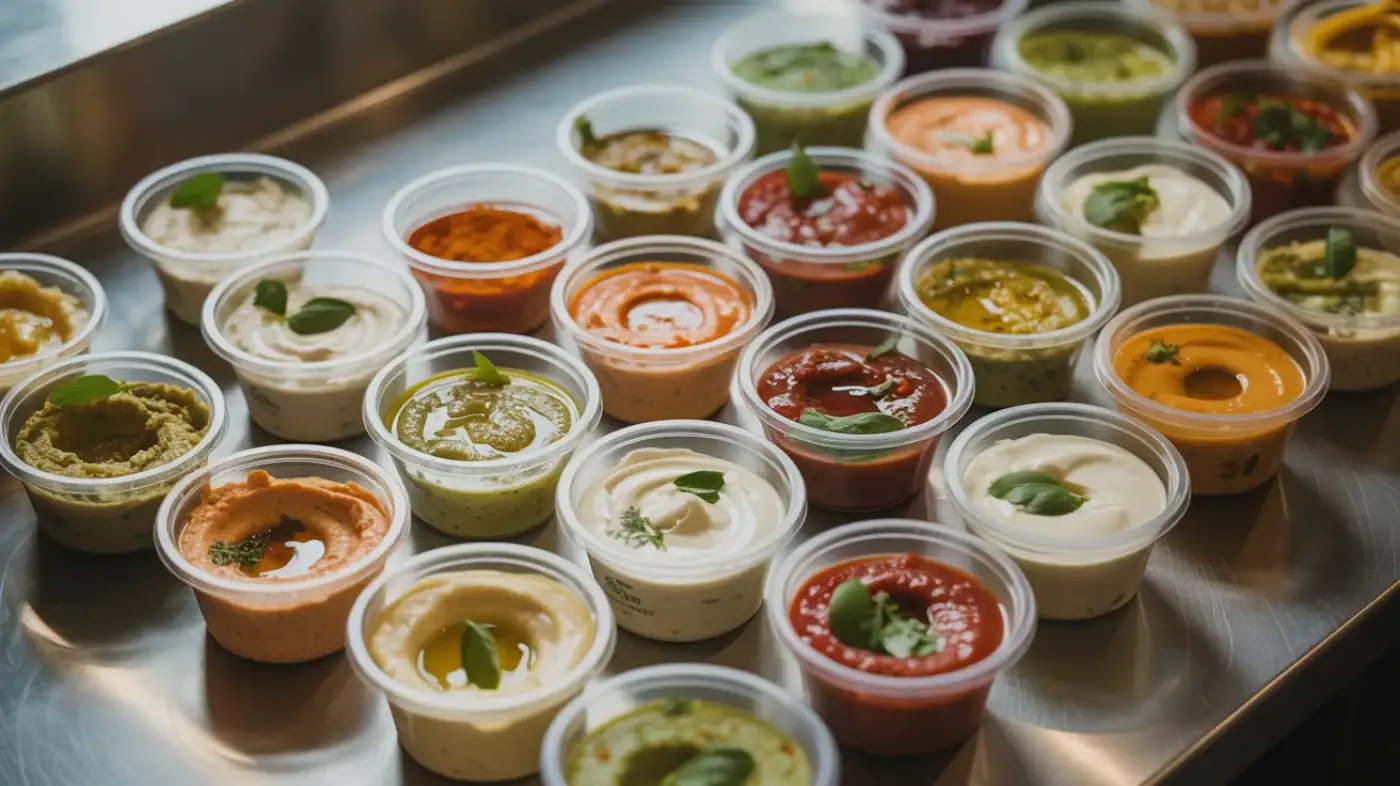
Tzatziki Filling Machine for Yogurt Dip with Shredded Cucumber
The SDH-R doses thin cultured yogurt and shredded cucumber into pre-formed cups, then seals, nitrogen-flushes and lids them in one rotary pass, at up to 30 cups per minute with ±0.5% fill-weight accuracy.
A tzatziki filling machine is an automatic cup filler that doses a low-viscosity yogurt base carrying shredded cucumber into pre-formed cups and seals them without contaminating the rim. The Hummus Pack SDH-R does this on a rotary platform: wide-bore, servo-driven piston filling at ±0.5% accuracy from 50 to 500 g, roll-film membrane sealing, optional nitrogen MAP and snap-on lids, at up to 30 cups per minute (18-25 real-world), from $45,000 USD.
- Output
- Up to 30 cups/min (18-25 real-world)
- Fill range
- 50 g - 500 g (approx. 2 oz - 17 oz)
- Fill accuracy
- ±0.5% (servo-driven volumetric piston)
- Cup sizes
- 4, 8, 10, 16 oz standard; 2-32 oz custom tooling
- Shelf-life option
- Nitrogen MAP, 0.3-0.4% residual oxygen
- Changeover
- Under ~15 minutes between SKUs
- Price
- From $45,000 USD
Tzatziki Filling Machine Built for Thin Yogurt and Shredded Cucumber
A tzatziki filling machine has a harder job than most dip fillers. It has to meter a low-viscosity cultured dairy base that behaves almost like a liquid, carry shredded cucumber through the valve without chopping it, and end every shot cleanly enough that the membrane seals on a dry flange. The Hummus Pack SDH-R, a fully automatic rotary cup filling, sealing and lidding machine, does all three in one pass, at up to 30 cups per minute on a dry cycle and 18 to 25 cups per minute on real product.
Thin dips punish hand-packing. Tzatziki runs off the scoop, splashes the rim and scatters several grams either side of target, so packers overfill as insurance and still find leakers in the cooler. The SDH-R replaces that bench with servo-driven volumetric piston metering held to ±0.5% fill-weight accuracy from 50 g to 500 g, which is where the machine earns back its price: in yogurt you stop giving away, shift after shift. Full specifications are on the SDH-R cup filling and sealing machine page, and the same platform runs our wider dip filling and sealing machine range.
How the SDH-R Tzatziki Cup Filling Machine Works, Station by Station
The SDH-R is a rotary cup filling machine: an indexing turret carries each cup through a fixed sequence of stations, so every cup sees the same fill, seal and timing.
- Denesting: a pneumatic denester places pre-formed round, square or rectangular cups into the turret carriers.
- Base fill: the servo-driven volumetric piston deposits a measured dose of tzatziki through wide-bore valving.
- Second and third fill (optional): an olive oil drizzle by peristaltic pump, a dill or garlic garnish, or a dry seasoning by vibration filler.
- Membrane sealing: roll-fed film is heat-sealed to the flange and cut, with temperature, pressure and dwell set independently.
- Nitrogen MAP flushing (optional): headspace oxygen is displaced, bringing residual oxygen down to 0.3-0.4%.
- Lid application (optional): a pick-and-place unit snaps on a plastic overcap.
- Discharge: finished cups leave on a conveyor toward coding, labeling or case packing.
Because the cup moves from filler to sealer in a few index steps, the time between deposit and closure is measured in seconds, not minutes, and on a product that starts weeping whey the moment it sits, that gap matters. The PLC and HMI store each SKU as a recipe with diagnostic alerts, so changeover takes under about 15 minutes.
Filling a Low-Viscosity Yogurt Base with Shredded Cucumber
Tzatziki is two products in one cup: a cultured dairy base, usually strained yogurt with garlic, olive oil and acid, that thins further as it is worked, and cucumber shreds that bridge narrow openings and keep releasing water. A cucumber yogurt dip filler has to respect both, and that is a nozzle and metering problem before it is a speed problem.
Wide-bore valving sized to the shred
A tight valve shears cucumber into pulp, which releases more water into the base. We size large-bore valving and nozzle geometry to your largest shred, so the cucumber passes intact and every cup carries the texture the recipe was written around. If you run both coarse- and fine-grated SKUs, tell us both cuts; the bore has to suit the coarser one.
Piston metering instead of pumping
The servo-driven volumetric piston moves a measured volume at a controlled velocity rather than forcing product through a pump, keeping shear low on a base whose gel breaks down when overworked. Stroke length and speed are set per recipe, so a thin tzatziki can be deposited at a gentler, splash-free rate than a stiff hummus on the same machine.
Positive cut-off and a dry flange
Without a clean end to the shot, tzatziki strings and drips onto the flange, and dairy residue under a membrane is the classic cause of leakers found days later in the cold chain. A suck-back nozzle draws the last of the product back into the tip for drip-free filling, while a cut-off nozzle closes the outlet positively; we confirm which suits your viscosity and shred size.
- Cucumber cut and shred length set nozzle bore and valve geometry.
- Yogurt solids, oil and acid set the viscosity window the piston is tuned to.
- Fill temperature is specified against your real batch, not a lab ideal.
Include these details in your tzatziki filling machine quote request and we will size the nozzle, piston and fill profile to match.
How to Minimize Syneresis and Whey Weeping in Tzatziki Cups
Syneresis is the release of whey from a yogurt gel. In tzatziki it shows up as a pool on the surface or a wet ring under the lid, and shoppers read it as a stale product even when it is perfectly safe. Three controls do most of the work.
1. Drain the cucumber before it meets the yogurt
Cucumber is mostly water and keeps losing it after it is cut. Salting, resting and pressing or spinning the shreds before mixing takes that water out at the prep table instead of in the sealed cup. It also stabilizes density, which matters to a volumetric filler: a batch that weeps in the hopper is thinner at the end than at the start.
2. Fill cold and keep hopper dwell short
A cultured gel holds its whey better cold than warm, so fill at a chilled, pumpable temperature and keep product moving. Top up the hopper with smaller, frequent batches rather than one large charge that separates for an hour, and avoid recirculating or agitating the base. Fill temperature limits for your recipe are confirmed with our engineering team before quoting.
3. Seal fast and seal clean
Every minute between deposit and closure lets whey rise. On the SDH-R the cup reaches the sealing station a few index steps after filling, and the dry flange left by the nozzle lets the membrane close on clean plastic. An optional weight checker with a feedback loop tracks fill weight as the batch ages, so density drift is caught rather than shipped. The same principles apply to plain and flavored cultured dairy on our yogurt filling application page.
Get a configured SDH-R quote for your productSend your product, cup size and target cups per minute — we reply within 24 hours.
Request a quoteTzatziki Defects, Causes and the SDH-R Setting That Prevents Them
Most tzatziki line problems trace back to a short list of causes. Use this table as a checklist when you prepare your product details for a quote.
Common tzatziki packaging defects, likely causes and SDH-R settings
| Defect | Likely cause | SDH-R setting or option |
|---|---|---|
| Whey pooling on the surface after sealing | Undrained cucumber, warm product, over-sheared base, long hopper dwell | Low-shear piston metering, chilled fill, small frequent hopper top-ups, short fill-to-seal index |
| Leakers or weak seals found in the cooler | Yogurt or whey on the sealing flange | Suck-back or cut-off nozzle, independent seal temperature, pressure and dwell |
| Strings or drips on the rim | Thin base tailing after the shot | Suck-back nozzle and a gentler stroke speed stored per SKU |
| Nozzle bridging or uneven cucumber per cup | Bore narrower than the longest shred | Wide-bore valving sized to the largest cut |
| Mushy, pulpy cucumber | Shear in a tight valve or pump | Large-bore valve with piston displacement instead of pumping |
| Fill weight drifting late in the run | Base thinning as whey separates in the hopper | Servo piston at ±0.5%, optional weight checker with feedback loop |
| Olive oil drizzle pooling to one side | Dose too large or nozzle off-center | Peristaltic pump dose and nozzle position set per recipe |
| Garlic flavor in the next mild SKU | Garlic oils held in seals, hoses and piston bores | Tool-free strip-down, CIP, mild-to-strong run order |
| Wrinkled film or distorted cup rim | Excess seal heat or dwell on thin-wall cups | Seal temperature and dwell matched to film and cup |
| Surface discoloration or short code life | Headspace oxygen, contamination, broken cold chain | Optional nitrogen MAP to 0.3-0.4% residual oxygen, plus sanitation and cold storage |
Olive Oil, Dill and Garlic: Multi-Station Tzatziki Packaging Machine Setups
A plain cup of tzatziki is one fill; a premium cup with an olive oil swirl and dill garnish is three. On a hand line each extra component is another person and another chance to touch the rim. The SDH-R takes up to three fillers in one pass, so a garnished SKU is finished in the same rotary cycle as the base, with no second handling step.
- Base: tzatziki, cacik, raita or another cultured yogurt dip, through the wide-bore servo piston.
- Olive oil or garlic oil drizzle: a peristaltic pump meters a small, repeatable shot across the surface.
- Dill, mint, garlic or olive garnish: the garnish filler places chopped herbs, roasted garlic, olives or extra cucumber on top.
- Dry seasoning: the vibration filler doses sumac, paprika or dried dill blends.
Order matters. Oil applied before a garnish helps herbs stay where they land, while garnish applied first reads more clearly through a clear overcap. We also check how much oil the surface can carry before it migrates toward the flange, because oil on the sealing area damages the seal as surely as yogurt. For topped and layered products, see our guide to multi-component filling for layered dips and parfaits.
Sealing and MAP Nitrogen Flushing for Yogurt Dip Shelf Life
Cultured dairy is unforgiving at the seal. A trace of yogurt or cucumber liquor on the rim stops the film wetting out, and a pack that looks perfect leaving the line leaks in a distributor's cooler days later. The SDH-R closes each cup with a tamper-evident roll-film membrane heat seal, with temperature, pressure and dwell set independently so you get a full weld without overheating a chilled thin-wall cup. Pre-die-cut lids suit specific artwork or barrier films, and a snap-on overcap suits tzatziki, which consumers open and return to the fridge several times.
What MAP does for tzatziki
Optional nitrogen flushing displaces headspace oxygen, reducing residual oxygen to 0.3-0.4%. On a live cultured product, lower oxygen slows the surface changes and off-notes that make a dip look tired, and helps the cucumber stay fresh-looking rather than grey and watery. Typical refrigerated shelf life for fresh dips moves from roughly 7-10 days to 30-45 days or more, depending on the product. See our MAP cup filler page for the system in detail.
- Longer dating supports regional retail and club distribution instead of local delivery only.
- MAP does not stop whey separation; that is controlled at prep, fill temperature and fill-to-seal time.
- MAP complements, and never replaces, cold chain, sanitation and your own validated shelf-life study.
Dairy Allergen Control, Garlic Carry-Over and Cold Chain on a Tzatziki Line
Milk is a major food allergen under the US Food Allergen Labeling and Consumer Protection Act (FALCPA), and many tzatziki lines share equipment with non-dairy products such as hummus or dairy-free tzatziki. If any SKU contains tahini, sesame became the ninth major US allergen on January 1, 2023 under the FASTER Act. Changeover between allergen families needs a cleaning step you can validate and document.
The SDH-R is built from food-grade 304 stainless steel with tool-free strip-down, and a CIP (clean-in-place) system is available as an option. It is designed to support plants operating under HACCP, FDA FSMA Preventive Controls (21 CFR Part 117), BRCGS or SQF, and Canada's Safe Food for Canadians Regulations; certification belongs to your plant's food safety program, not to the machine.
Garlic carry-over between flavors
Garlic oils cling to seals, hoses and piston bores, and a mild dill dip run straight after a heavy garlic tzatziki will taste of garlic unless the filler is properly cleaned. Schedule mild SKUs first and strong garlic last, with a validated clean between flavor families. The same discipline applies on our sour cream filling machine configuration, where onion and garlic dips share lines with plain product.
Cold chain from mixer to cooler
The SDH-R targets fresh, refrigerated cups filled at a pumpable temperature; it is not an aseptic or retort system, so product safety depends on keeping tzatziki cold before, during and after filling. Many plants reference the 41°F (5°C) cold-holding limit in the FDA Food Code, but your HACCP or preventive controls plan sets the limit for your product.
- Plan breaks and changeovers so a filled hopper is never left warming.
- Move sealed cups from the discharge conveyor into cold storage without an ambient queue.
Cup Sizes, Multipacks and Retail Formats for Tzatziki
The SDH-R handles 4, 8, 10 and 16 oz cups as standard, with custom tooling from 2 oz to 32 oz in round, square or rectangular shapes. The standard fill range is 50 g to 500 g, so fills above 500 g are confirmed with our engineering team.
Typical tzatziki cup formats on the SDH-R
| Cup size | Typical use | SDH-R tooling |
|---|---|---|
| 2 oz | Foodservice and meal-kit side portions | Custom tooling; near the 50 g minimum |
| 4 oz | Single-serve retail and snack packs | Standard |
| 8 oz | Core retail cup | Standard |
| 10 oz | Retail cup, often square or rectangular | Standard |
| 16 oz | Family size and club packs | Standard |
| 24-32 oz | Deli and foodservice tubs | Custom tooling; fills above 500 g confirmed with engineering |
Multipacks and downstream packing
The SDH-R fills and seals individual pre-formed cups; it does not thermoform cups or form joined multipack cups. Club twin packs or trays of snack cups are assembled downstream by sleeving, banding or case packing. The optional discharge conveyor extension gives that equipment a clean hand-off, and top and side labeling plus variable data coding put lot codes and dates on each cup before grouping. For very small formats, see our portion cup filling machine page.
A Tzatziki Filling Machine for Greek and Mediterranean Producers in North America and Europe
Tzatziki is made by family Greek and Mediterranean dairies, commissary kitchens, private-label co-packers and specialty yogurt brands, many of which also run hummus, baba ganoush or labneh. The SDH-R is designed and built in Calgary, Alberta, Canada, powered by Alter Pack. We serve food producers across the USA, Canada, the UK, the EU, the Middle East, Australia and New Zealand, with service centers in Alberta, New Jersey and California; see our United States service coverage.
As a Greek yogurt dip filling machine for export markets, the SDH-R carries CE marking, UL listing and FDA-compliant food-contact materials; European producers should confirm their own food-contact documentation under Regulation (EC) 1935/2004. Plants packing tzatziki alongside chickpea dips often run the same platform as our hummus filling machine, sharing spares, training and recipe structure.
When the SDH-R is not the right machine
- Single-SKU volume well above 30 cups per minute, where an inline cup filling machine is the better choice.
- Shelf-stable tzatziki-style sauces that need aseptic filling or retort processing.
- Frozen products, or cups you want thermoformed on the same machine.
- Fills below 50 g, such as 1 oz sauce cups.
Tzatziki Filling Machine Price, Lead Time and Quote Process
The SDH-R starts from $45,000 USD for the single-filler configuration. Price scales with additional filler stations, nitrogen MAP, snap-on lidding, labeling and coding, a weight checker and custom tooling, so a line with drizzle and garnish stations sits above the entry price.
- Lead time: 8-12 weeks from order confirmation.
- Warranty: 12 months.
- Footprint: 44 × 52 in (1,100.5 × 1,315.5 mm), 65.6 in (1,666 mm) high.
- Support: service centers in Alberta, New Jersey and California.
How to get a tzatziki filling machine quote
- Describe your product: recipe type, cucumber cut, oil and garnish components, and fill temperature.
- List your cup sizes, shapes and target fill weights.
- Give your target cups per minute and options, such as MAP, lids, labeling, coding or checkweighing.
- Our engineering team may reach out about the application, and we reply within about 24 hours.
Request a tzatziki filling machine quote or call +1 (888) 922-7271, Monday to Friday, 9:00 AM to 5:00 PM MT. For what drives the number, read our breakdown of cup filling and sealing machine cost.
Tzatziki Filling Machine Start-Up Checklist for 2026
What should you prepare before commissioning a tzatziki filling machine? Have your drained cucumber specification, target weight and cup size ready, then agree the run order for dairy and garlic. A clear start-up plan shortens trials and makes the first production hour more predictable.
Start-up check and why it matters for tzatziki
| Check | Why it matters | Action |
|---|---|---|
| Cucumber shred size | Large pieces can bridge the valve | Confirm with engineering for wide-bore valving |
| Drainage of cucumber | Free water causes whey weeping | Standardize draining before blending |
| Fill weight | Sets piston and cup tooling | Choose within 50-500 g |
| Seal rim cleanliness | Residue weakens the membrane seal | Verify nozzle and drip control |
| Shelf-life promise | Oxygen reduces refrigerated life | Decide on nitrogen MAP flush |
Run a short trial with your real product before full production. Check weight consistency over several minutes, look for weeping after cooling, and confirm the seal holds on a sample of cups. The SDH-R stores settings in recipes, so a good trial setup can be recalled instead of rebuilt.
Production speed should be planned at 18-25 cups per minute rather than the 30 dry-cycle figure, with fill weight accuracy of ±0.5%. Pricing begins from $45,000 USD for the single-filler configuration, and adding a dill or oil station, MAP or labeling increases it. Delivery is 8-12 weeks, with a 12-month warranty.
Document the settings that worked. Once the trial gives you acceptable weights, a clean seal rim and no weeping after a day under refrigeration, save the stroke speed, nozzle and seal parameters as a named recipe on the HMI. Operators can then recall it for every later run, and changeover between tzatziki sizes or flavors stays under about 15 minutes, which keeps the line productive across a mixed schedule.
- Prepare a product sample description.
- Name the cup and film you will use.
- Decide on olive oil or garnish stations.
- See our yogurt filling page for the related dairy base.
Tzatziki Filling Machine — Frequently Asked Questions
The Hummus Pack SDH-R tzatziki filling machine starts from $45,000 USD for the single-filler configuration. Final price depends on the number of filler stations, such as a yogurt base fill plus an olive oil drizzle, your cup size range and tooling, and options like nitrogen MAP, snap-on lids, labeling, coding and a weight checker. Each machine carries a 12-month warranty, with delivery 8-12 weeks from order confirmation.
The SDH-R is rated at up to 30 cups per minute on a dry cycle. On real tzatziki, expect a sustained 18 to 25 cups per minute depending on cup size, fill weight and options, because a thin yogurt base needs a controlled, splash-free fill to keep the sealing flange dry. Larger 16 oz cups and extra garnish or drizzle stations sit toward the lower end of that range.
Not when the valving is sized correctly. On the SDH-R tzatziki filling machine, we size wide-bore valving and the nozzle to your largest cucumber shred, and the servo-driven volumetric piston moves product at a controlled velocity instead of forcing it through a pump. Shreds pass intact, and the shear-sensitive yogurt base is not worked hard enough to break down its gel.
Whey weeping, or syneresis, is controlled by three things together: draining salted cucumber before mixing, filling the yogurt base cold with short hopper dwell times, and sealing quickly on a clean flange. The Hummus Pack SDH-R helps with low-shear piston metering, a fill-to-seal transfer of a few index steps, and suck-back or cut-off nozzles that keep the rim dry. Formulation also plays a large part.
With the SDH-R's optional nitrogen MAP system, residual headspace oxygen drops to about 0.3-0.4%, and typical refrigerated shelf life for fresh dips moves from roughly 7-10 days to 30-45 days or more. Tzatziki results depend on your culture, acidity, cucumber prep, sanitation and cold chain, so treat these as planning figures and confirm them with your own validated shelf-life study.
The Hummus Pack SDH-R fills 4, 8, 10 and 16 oz cups as standard, in round, square or rectangular shapes, and accepts custom tooling from 2 oz to 32 oz. The standard fill range is 50 to 500 g, so 2 oz portion cups sit at the low end and fills above 500 g are confirmed with our engineering team. Changeover between sizes takes under about 15 minutes.
Yes. The SDH-R takes up to three fillers in one pass. A typical premium tzatziki setup uses the servo piston for the yogurt base, a peristaltic pump for an olive oil or garlic oil drizzle, and a garnish filler for chopped dill, mint, olives or extra cucumber. A vibration filler can add dry seasonings such as sumac. All stations index together, so garnished cups need no second handling step.
The SDH-R is built from food-grade 304 stainless steel with tool-free strip-down and an optional CIP system, so seals, hoses and piston bores that hold garlic oils and milk residue can be broken down and wet cleaned between runs. Schedule mild SKUs before strong garlic ones, and validate the clean between dairy and non-dairy products, because milk is a major allergen under FALCPA.
The Hummus Pack SDH-R tzatziki packaging machine ships 8-12 weeks from order confirmation and carries a 12-month warranty. It is designed and built in Calgary, Alberta, Canada, with service centers in Alberta, New Jersey and California. To start, send your product, cup sizes, target cups per minute and options; our team replies within about 24 hours.
Related machines & guides
Explore the pages most relevant to this application.
Why producers buy from Hummus Pack
Ready to Quote Your Tzatziki Filling Machine?
Get a personalized SDH-R configuration and price for your product, cup sizes, and production volume.