
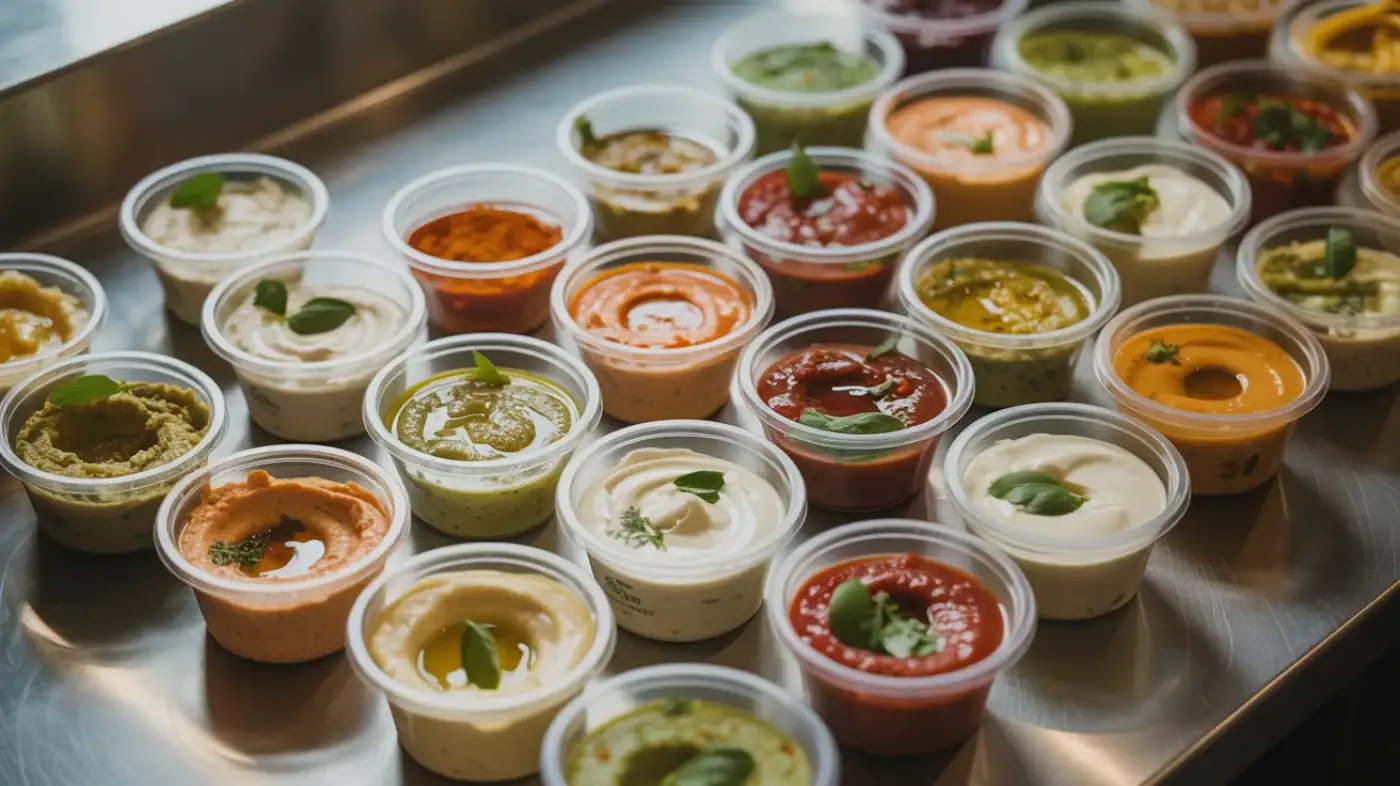
Salad Dressing Filling Machine for Dressing Cups, Salad Kits and Grab-and-Go
Dose creamy ranch, Caesar, blue cheese and thin vinaigrettes into pre-formed cups from 2 oz up, then heat-seal and lid them on one rotary dial. Servo piston accuracy of ±0.5%, an optional peristaltic pump for thin dressings, and drip-free suck-back nozzles.
A salad dressing filling machine meters creamy dressing or vinaigrette into pre-formed cups and seals them for salad kits and meal kits. The Hummus Pack SDH-R is a rotary salad dressing filling machine that doses 50-500 g per cup at ±0.5% using a servo-driven volumetric piston, or an optional peristaltic pump for thin dressings, then heat-seals a membrane and can snap on a lid. It reaches 30 cups per minute and starts at $45,000 USD.
- Machine
- SDH-R automatic rotary cup filling, sealing and lidding
- Fill range
- 50-500 g standard (2 oz cups are the low end)
- Accuracy
- ±0.5% with the servo-driven volumetric piston
- Thin dressings
- Optional peristaltic pump; suck-back (drip-free) nozzle
- Output
- 30 cups/min dry cycle; typically 18-25 on dressing
- Changeover
- Under ~15 minutes between SKUs with HMI recipes
- Price
- From $45,000 USD (single filler)
What a Salad Dressing Filling Machine Does on a Cup Line
A salad dressing filling machine for cups meters an exact portion of dressing into a pre-formed cup and closes it so it can ride inside a salad kit, a meal-kit box or a grab-and-go bowl without leaking. Our SDH-R does this on a rotary dial: cups are denested, dosed, membrane-sealed and, where you choose, nitrogen-flushed and snap-lidded before discharge. Configuration details are on the SDH-R product page.
Dressings are harder to package than they look. Ranch and Italian vinaigrette sit at opposite ends of the viscosity scale, most recipes are oily enough to spoil a heat seal, and one plant may run several allergen profiles in a week. The SDH-R fills cups and tubs only, not bottles, jars or sachets. For spoonable emulsions see our mayonnaise filling machine, and for dipping and barbecue sauces our sauce filling machine.
Creamy vs Thin Dressings: Choosing the Filler on a Dressing Filling Machine
Creamy dressings: ranch, Caesar, blue cheese
Creamy dressings are emulsions thickened with egg yolk, dairy, starch or xanthan gum. Most are shear-thinning, flowing readily under pressure and recovering body at rest, while a modest yield stress keeps herbs and cheese suspended. That suits the standard servo-driven volumetric piston, which delivers a set volume at ±0.5% fill-weight accuracy, with stroke speed stored per product in the HMI recipe.
Thin dressings and vinaigrettes
Water-thin vinaigrettes and soy-based dressings splash when driven fast and drip between doses. For these we offer an optional peristaltic pump, which moves liquid by squeezing a flexible tube, so inside the pump the dressing touches only the tubing. A piston with a suck-back nozzle also handles many thin products, and our engineers recommend one or the other once they understand your recipe. Our piston versus pump filler guide sets out the tradeoffs.
Drip control and foam
We recommend the suck-back nozzle for almost every dressing: it draws dressing back up the nozzle as each dose ends, so the tip leaves no tail on the rim. Foam is the other enemy. Buttermilk and egg-based dressings hold air, which shorts the fill, because a piston measures volume rather than weight, and pits the surface under clear film. Most air enters upstream, from over-long high-shear mixing, a return line splashing into the hopper or a pump drawing air at a loose clamp. Keep the hopper flooded, slow the stroke where foam appears, and fit the optional weight checker, whose feedback loop catches drift in grams.
Vinaigrette Filling Machine Considerations: Oil and Vinegar That Separate
An unstabilized vinaigrette is two liquids in one container. Once mixing stops, the lighter oil rises at a rate set by droplet size, water-phase viscosity and standing time. In a hopper that drains from the bottom, the first cups after a pause come out acid-heavy and the last ones oil-heavy, so fill weight can hit ±0.5% while the ratio inside each cup wanders.
Hopper agitation is not part of the SDH-R's standard specification, so we treat separation as a process design question:
- Stabilize the recipe. Mustard, egg yolk or gums such as xanthan turn a breaking vinaigrette into an emulsified one that holds through a run.
- Shorten residence time. Feed the hopper continuously from a mixed tank upstream and hold a low, steady level.
- Dose the phases separately. With up to three fillers per pass, a vinegar base and an oil component could be dosed as two components; that is an engineering review, not a standard configuration.
- Check the ratio, not only the weight. Settle cups from the start, middle and end of each hopper cycle in a graduated cylinder and log the oil fraction.
Salad Dressing Packaging Machine Setup by Dressing Type
As a starting point only: final nozzle, valve bore and filler are confirmed with our engineering team against your product and fill temperature, then tuned at commissioning.
Dressing type versus SDH-R filler and nozzle setup
| Dressing | Filling behavior | Suggested setup |
|---|---|---|
| Buttermilk ranch | Shear-thinning, holds air, herb flecks | Servo piston, suck-back nozzle, moderate stroke, weight checker |
| Caesar | Thick; grated cheese; often anchovy | Servo piston, suck-back nozzle, fish and milk allergen sequencing |
| Blue cheese | Heavy body, soft crumbles | Piston with large-bore valving; confirm crumble size |
| Honey mustard | Sticky, long cutoff tail | Piston with suck-back; stroke tuned at commissioning |
| Emulsified vinaigrette (balsamic, Dijon) | Pourable, stable through a run | Peristaltic pump or piston with suck-back |
| Separating vinaigrette (Italian) | Thin; splits in the hopper | Peristaltic pump, short residence time, ratio checks; review agitation with engineering |
| Sesame-ginger | Thin; seeds may not stay suspended | Peristaltic pump or piston; sesame, soy and wheat controls |
| Yogurt or tahini dressing | Thick; weeps if overworked | Servo piston, gentle stroke, cool fill |
Garlic emulsions behave more like a spread than a pourable dressing; see our aioli filling machine page.
Get a configured SDH-R quote for your productSend your product, cup size and target cups per minute — we reply within 24 hours.
Request a quoteDressing Cup Filling Machine for Meal Kits, Salad Kits and Grab-and-Go
Most dressing that leaves a plant in a cup rides inside something else: a salad kit, a meal-kit box or a grab-and-go bowl. Nobody notices that cup until it leaks onto the greens. As a dressing portion cup filler, the SDH-R covers these formats:
- 2 oz portion cups, the common kit format, are the smallest cups in the standard range, since fills start at 50 g; they need matching tooling.
- 1 oz and 1.5 oz cups hold under 50 g, outside the standard range.
- 4, 8, 10 and 16 oz cups have standard tooling and suit deli, family meal kits, foodservice sides and retail tubs, up to the 500 g maximum fill.
At 18 to 25 dressing cups a minute in production, depending on viscosity, cup and options, eight hours of steady running yields roughly 8,600 to 12,000 cups. For plants filling for several kit brands, SKU changeover of under about 15 minutes with saved HMI recipes often matters more than top speed. Single-serve sizes are covered on our portion cup filling machine page; to portion the salad itself, see the salad filling machine.
Oily Flanges and Seal Integrity in Salad Dressing Packaging
Oil is the main reason dressing cups leak. A heat seal forms when the film's sealant layer fuses to the cup flange; a thin film of oil prevents that fusion while leaving a seal that looks fine on the line, and the channel leak surfaces after the cup is squeezed into a kit and shipped. Thin vinaigrettes spread fastest across a plastic flange, but one drip of ranch does the same damage.
Keeping the flange clean
- Leave headspace below the flange and keep stroke speed low enough that dressing does not wave up the wall.
- Use a suck-back nozzle and confirm at commissioning that the tip leaves no tail as the dial indexes.
- Center cups in tooling matched to your cup so the dose never lands near the rim.
- Ask your film supplier to confirm the sealant layer suits your cup material and an oily product.
Seal temperature, pressure and dwell
Seal quality then comes down to sealing temperature, pressure and dwell time, set at commissioning for your film and cup, with recipe storage keeping each SKU's settings together. Peel, squeeze or inversion checks and a periodic vacuum leak test catch a drifting seal before pallets ship.
Allergens in Salad Dressings and Changeover Cleaning
Few product families stack as many allergens on one line:
- Egg: mayonnaise-style bases in ranch, Caesar and honey mustard.
- Milk: buttermilk, sour cream, Parmesan and blue cheese.
- Fish: anchovy in classic Caesar and in Worcestershire sauce.
- Mustard: a priority allergen in Canada and a listed allergen in the EU, but not a major US allergen, which catches out cross-border producers.
- Sesame: Asian-style and tahini dressings; added to the US major allergen list on January 1, 2023, as the ninth.
- Soy, wheat and sulphites: soy sauce in sesame-ginger dressings, and sulphites, a Canadian priority allergen, in some wine vinegars.
The lists come from the FDA's major food allergens and Health Canada's priority food allergens; if you use precautionary labeling, see the CFIA's guidance on cross-contamination statements.
A flavor changeover and an allergen changeover are different jobs. Moving between two ranch SKUs is a quick recipe change; moving from Caesar to an egg-free, fish-free vinaigrette is a validated clean. On the SDH-R, product-contact parts come off without tools, the machine is built in food-grade 304 stainless, and an optional clean-in-place (CIP) system runs wash cycles that shift the emulsified fat a quick rinse leaves behind. Schedule runs from fewest allergens to most, then verify each clean with allergen testing. US plants record it in the food safety plan required by 21 CFR Part 117 (FSMA preventive controls); Canadian plants record it in the written Preventive Control Plan the Safe Food for Canadians Regulations call for. Our post on HACCP plans for dips, sauces and spreads walks through building the hazard analysis.
Acidity, Cold Chain and Nitrogen Flush for Dressing Cups
General guidance only: your process authority sets pH, preservatives and shelf life for each recipe. Most dressings rely on vinegar or citrus for acidity, but creamy styles dilute it and fresh-style recipes also lean on refrigeration. The SDH-R is built for that refrigerated category, filling at a pumpable temperature. It is not hot-fill rated, aseptic or retort, and our engineers check any unusual fill temperature before we quote.
In the US, "salad dressing" is also a standardized food: under 21 CFR 169.150 it is a spoonable emulsion with at least 30 percent vegetable oil by weight and egg yolk ingredients equal to at least 4 percent liquid egg yolk, and it may be packed under nitrogen or carbon dioxide. Your labeling team decides which names and standards apply to each SKU.
Oxygen turns dressing oils rancid. Flushing the headspace with nitrogen, an SDH-R option, leaves 0.3-0.4% residual oxygen once the film is sealed. We do not quote a dressing shelf life, since it depends on recipe, acidity, film barrier and cold chain; see our guide to shelf-life testing for food products and our MAP cup filler page.
When Another Dressing Filling Machine Is the Better Choice
We would rather say early that the SDH-R is the wrong fit. Look elsewhere for:
- Bottles, jars, sachets or pouches, which need bottling or form-fill-seal equipment.
- 1 oz or 1.5 oz cups, under the 50 g minimum.
- A single SKU needing far more than 30 cups a minute, where a multi-lane inline line pays off; see our rotary versus inline comparison.
- Shelf-stable, hot-filled, aseptic or retorted dressing.
- Foodservice pails above 500 g.
Sitting on a boundary? Talk to our engineering team before budgeting.
Salad Dressing Filling Machine Price, Lead Time and Quote
Pricing for the SDH-R begins at $45,000 USD for one filler. Each addition raises it: a second or third filler, the peristaltic pump, nitrogen MAP, lidding, CIP, the weight checker, labeling or custom cup tooling. Expect delivery 8-12 weeks after you confirm the order; the warranty runs 12 months. We design and build every SDH-R in Calgary, Alberta, with service support from our Alberta, New Jersey and California centres.
For a quote, send us:
- Each dressing: creamy, emulsified or separating, plus any particulates.
- Cup size, shape and target fill weight.
- Target cups per minute.
- Closures and whether you want nitrogen flushing.
- Allergen profile and fill temperature.
Our team may phone with questions about the application; expect a reply within about 24 hours. Request a salad dressing filling machine quote online, phone +1 (888) 922-7271 or write to sales@hummuspack.com. The office is open weekdays from 9:00 AM until 5:00 PM MT.
Sources and review
Every SDH-R figure on this page is checked line by line against the SDH-R engineering specification, as set out in our editorial policy. The regulatory and food-safety notes rely on these official sources, which we checked when this page was last updated:
- eCFR: 21 CFR 169.150, Salad dressing (standard of identity)
- eCFR: 21 CFR Part 117, CGMP and Risk-Based Preventive Controls for Human Food
- U.S. FDA: Food Allergies (major food allergens)
- Health Canada: Common food allergens (priority allergens)
- CFIA: Allergen-free, gluten-free and cross-contamination statements
- Justice Laws: Safe Food for Canadians Regulations (SOR/2018-108)
Regulatory information here is general guidance, not legal advice; confirm your obligations with the authority or a qualified advisor. Spotted something out of date? Email sales@hummuspack.com or call +1 (888) 922-7271.
Salad Dressing Filling Machine — Frequently Asked Questions
Hummus Pack prices the SDH-R salad dressing filling machine from $45,000 USD in its one-filler form. Extra fillers, the peristaltic pump, nitrogen flushing, lidding, CIP, labeling and custom cup tooling each add to that figure. Machines ship 8-12 weeks after order confirmation and carry a 12-month warranty. To get a number for your line, list your dressings, cups and target speed on our quote request page.
Yes, with the right setup. For thin vinaigrettes the SDH-R uses an optional peristaltic pump or its servo-driven piston with a suck-back nozzle, which draws dressing back into the tip as each dose finishes, so nothing drips onto the cup flange. Our engineers set nozzle bore, stroke speed and suck-back timing for your dressing and cup during commissioning.
Hopper agitation is not part of the SDH-R's standard specification. Separating vinaigrettes are managed by stabilizing the recipe, feeding the hopper continuously from a mixed tank upstream, or reviewing separate dosing of oil and vinegar with two of the machine's up to three fillers. Raise agitation needs early so our engineering team can assess them.
Two-ounce portion cups are the smallest dressing cups inside the SDH-R's standard 50-500 g fill window, and they need matching tooling. A 1 oz or 1.5 oz cup holds under 50 g of dressing, so it falls outside that window. Stock tooling runs 4, 8, 10 and 16 oz cups; custom change parts reach from 2 oz up to 32 oz.
On a dry cycle the SDH-R indexes 30 cups a minute. Filling real dressing it usually settles between 18 and 25, with viscosity, cup size, fill weight and options deciding where in that band a line lands. That is about 1,100 to 1,500 sealed cups an hour. If one SKU needs far more than 30 a minute, a multi-lane inline line is the better investment.
Treat flavor changes and allergen changes separately. Switching between two dressings with the same allergens is an HMI recipe change of under about 15 minutes on the SDH-R. Going from Caesar (egg, milk, fish) to an allergen-free vinaigrette needs a validated clean, made easier by tool-free strip-down, 304 stainless construction and the optional CIP system. Your plant validates and verifies it under its allergen control plan.
No. The SDH-R only handles pre-formed cups and tubs, in round, square or rectangular shapes. Bottles, squeeze bottles, jars, pouches, stick packs and sachets need other equipment. Where it fits is salad dressing packed in a cup for a salad kit, meal kit or grab-and-go bowl, or in a refrigerated retail tub holding up to 500 g.
With the SDH-R's optional nitrogen flush, a sealed dressing cup holds only 0.3-0.4% residual oxygen, which slows the oxidation that turns salad dressing oils rancid. Actual shelf life depends on recipe, acidity, preservatives, film barrier and cold chain, so we do not promise a figure for dressings; confirm it through your own shelf-life testing before setting a code date.
Related machines & guides
Explore the pages most relevant to this application.
Why producers buy from Hummus Pack
Ready to Quote Your Salad Dressing Filling Machine?
Get a personalized SDH-R configuration and price for your product, cup sizes, and production volume.