
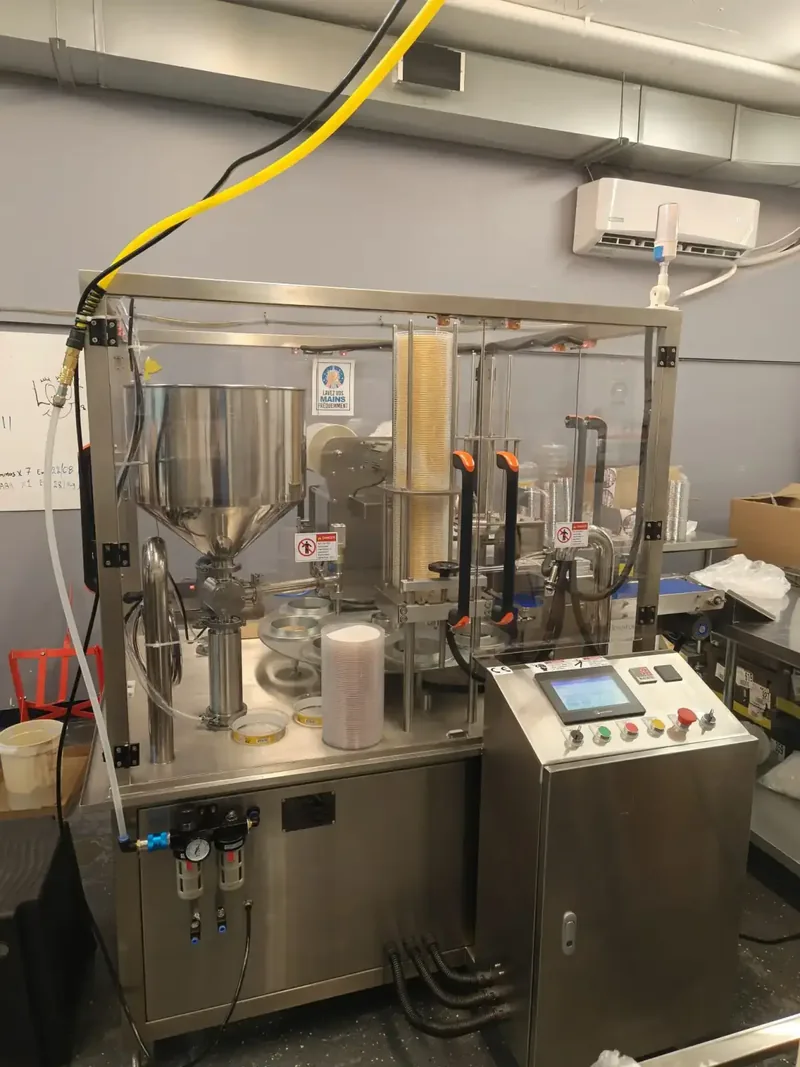
Co-Packing Equipment: A Cup Filling Line Built for Co-Packers
Run dips, spreads, sauces and dairy cups for many client brands on one SDH-R line, with an HMI recipe for every SKU, changeover in under about 15 minutes and ±0.5% servo fill accuracy at 18-25 cups a minute.
Co-packing equipment for cup products has to switch client SKUs quickly, hold declared net weights tightly and strip down fast for allergen cleaning. The SDH-R, our Calgary-built rotary cup filler, recalls a stored HMI recipe for each client SKU, changes over in under about 15 minutes, fills pre-formed cups from 50 to 500 g at ±0.5% and produces 18-25 cups a minute in real production. Pricing begins at $45,000 USD.
- SKU changeover
- Under ~15 minutes, with HMI recipe storage
- Fill range & accuracy
- 50-500 g at ±0.5% (servo-driven volumetric piston)
- Real-world output
- 18-25 cups/min (up to 30 cups/min dry cycle)
- Cup formats
- 4, 8, 10, 16 oz standard; 2-32 oz custom; round, square, rectangular
- Fillers per pass
- Up to 3 (piston, vibration, garnish, peristaltic)
- Sanitation
- 304 stainless steel, tool-free strip-down, optional CIP
- Price & delivery
- From $45,000 USD; 8-12 weeks; 12-month warranty
What Co-Packing Equipment Must Handle That a Brand's Own Line Does Not
Co-packing equipment is the filling, sealing, coding and packing machinery a contract manufacturer uses to make food under other companies' brands, and for refrigerated cups the filling line carries most of the risk. A brand's own line runs a handful of its own formulas. A co-packer's line runs whatever the next contract brings: a new cup diameter, a stiffer paste, a different lidding film, one client who insists on sesame-free and another whose product is half tahini.
So the right co-packing equipment is not the fastest machine on a spec sheet; it is the one that loses the least time and product each time the job changes. That was the brief behind our Calgary-built SDH-R cup filler, sealer and lidder. Brands still deciding whether to outsource should read our co-packer vs in-house production article instead.
Changeover Time Is the Core Spec for a Co-Packer Machine
A contract packer earns while cups move and loses while the line sits between clients. A busy week can mean eight SKUs for four brands, some only a few thousand cups each, so changeover matters more to a co-packer machine than headline speed. The SDH-R needs less than about 15 minutes to switch SKUs, and its HMI stores recipes, so a returning client's settings are recalled, not rebuilt from notes.
Cup formats one line can accept
Standard tooling covers 4, 8, 10 or 16 oz cups, and matching change parts open custom sizes anywhere between 2 oz and 32 oz, round, square or rectangular. With standard fills of 50-500 g, a 2 oz portion cup is the low end, 1 oz sauce cups fall outside the range, and heavy fills in big tubs get an engineering check first.
A changeover routine worth standardizing
- Empty the hopper and keep a labeled retention sample from the last cups.
- Swap cup tooling and, if needed, the nozzle: suck-back for stringy products, large-bore valving for chunky salsa or cucumber-heavy tzatziki.
- Load the client's film or lids and check the print against the work order.
- Recall the client's HMI recipe and set the coder's lot and date format.
- Check first-off cups for weight, seal, code and label before releasing the job.
Allergen Control and Client Segregation on Contract Food Packaging Equipment
Shared lines get audited hardest on allergens. Hummus and tahini contain sesame, which the FASTER Act added as the ninth major allergen in the US from the start of 2023; tzatziki, labneh and cream cheese contain milk; pesto usually has cheese and often nuts. For US plants, 21 CFR Part 117 expects allergen controls that prevent cross-contact and keep finished food correctly labeled, plus sanitation controls for food-contact surfaces.
On co-packing equipment, the machine's part is making cleaning practical. SDH-R product-contact parts are food-grade 304 stainless and come off without tools, and CIP (clean-in-place) is optional. What satisfies a client's auditor is your program: a written procedure, validation that it removes the allergen, and verification after every clean, as laid out in our HACCP plan guide for dips, sauces and spreads.
Segregation habits that hold up in audits
- Run allergen-free and single-allergen SKUs first after a full clean, and sesame- or nut-heavy SKUs last.
- Verify each clean, for example with an allergen-specific swab, before the next client starts.
- Store each client's film, lids and labels apart; the wrong film or label is a simple route to an undeclared allergen.
- Log each changeover and clean against the lot codes either side of it.
Client Audits, Registrations and Licences for Co-Packing Plants
Retail-bound clients commonly require a plant certificate under a GFSI-benchmarked scheme such as SQF or BRCGS. Those schemes certify a site and its management system, not a machine, so no filler holds SQF or BRCGS certification; the SDH-R supports plants that run under them by making cleaning, inspection and record-keeping easier to do and to prove.
Registration also sits with the plant. US facilities that manufacture, process, pack or hold food for US consumption register with the FDA under 21 CFR Part 1, Subpart H, renewing between October 1 and December 31 of each even-numbered year, so the current window closes on December 31, 2026; unless exempt or qualified, they also keep a Part 117 food safety plan. In Canada, the CFIA says packaging or labelling food for export or interprovincial trade generally needs a Safe Food for Canadians licence.
Co-packing equipment evidence clients ask for
- Materials: 304 stainless steel construction and FDA compliant food-contact materials.
- Conformity: CE marking and UL listing.
- Records: cleaning and CIP logs, preventive maintenance, weight checker verification and the recipe used for each lot.
Our compliance overview for the SDH-R separates what the machine carries from what stays the plant's responsibility.
Get a configured SDH-R quote for your productSend your product, cup size and target cups per minute — we reply within 24 hours.
Request a quoteNet Quantity, Giveaway and Per-Client Coding
Every cup that leaves your co-packing equipment carries a client's declared net quantity, and compliance is statistical. US weights and measures inspectors test lots under NIST Handbook 133, which checks the lot average and caps individual shortfalls at a maximum allowable variation; Canada's SFCR use an average system for net quantity. Either way, fill variability forces a target above the declaration, and that overfill is product given away.
Because the SDH-R doses through a servo-driven volumetric piston accurate to ±0.5%, that band narrows. Giveaway = (target fill − declared fill) × cups. On a 283 g (10 oz) declaration, each 1% of overfill is about 2.8 g per cup, roughly 28 kg across a 10,000-cup run. An optional checkweigher feeding back to the filler corrects drift as density changes. When clients supply the product, giveaway is their loss, so share fill data by lot.
Coding and labels for many brands
Optional variable data coding prints each client's lot and date format in line, and integrated top and side labeling removes a separate packing step. For market rules, including Canadian bilingual labels, see our labeling requirements guide for dips and spreads.
Quoting Client Jobs on a Co-Packer Cup Filling Line
Quotes that ignore changeover and cleaning lose money on short runs. Build line time for each job from five variables: N = cups ordered; R = sustained cups per minute (plan on 18-25 for the SDH-R, confirmed in a trial); k = changeovers; C = minutes per changeover (under about 15); S = cleaning minutes.
Filling time for one SKU before changeover and cleaning, at 18 and 25 cups a minute
| Cups ordered | At 18 cups/min | At 25 cups/min |
|---|---|---|
| 2,500 | 139 min (2.3 h) | 100 min (1.7 h) |
| 5,000 | 278 min (4.6 h) | 200 min (3.3 h) |
| 10,000 | 556 min (9.3 h) | 400 min (6.7 h) |
| 25,000 | 1,389 min (23.1 h) | 1,000 min (16.7 h) |
At 25 cups a minute a 2,500-cup job fills in about 100 minutes, so one 15-minute changeover adds roughly 15% to the slot before cleaning. Our filling machine capacity sizing guide covers shifts, utilization and headroom for co-packing equipment.
Co-Packer Requirements Mapped to SDH-R Co-Packing Equipment Features
Use this table as a checklist when comparing co-packing equipment from different suppliers.
Co-packer requirement vs SDH-R feature
| Co-packer requirement | SDH-R feature or option |
|---|---|
| Many client SKUs, short runs | Stored HMI recipes; SKU change in under ~15 minutes |
| A different cup per client | 4-16 oz standard tooling; 2-32 oz custom change parts; round, square, rectangular |
| Thin dressings to stiff pastes | Servo piston standard; optional peristaltic pump |
| Allergen changeovers | 304 stainless build; strips down without tools; CIP optional |
| Declared net quantity | ±0.5% fill accuracy; optional checkweigher feedback |
| Per-client traceability | Optional variable data coding; top and side labeling |
| Topped or layered products | Up to three fillers, including vibration and garnish fillers |
| Longer distribution windows | Optional nitrogen MAP, 0.3-0.4% residual oxygen |
| Tight floor space | 44 × 52 in footprint, 65.6 in high |
| Audit-ready equipment | CE, UL listed, FDA compliant food-contact materials |
Multi-Component Filling and MAP: Services a Co-Packing Machine Can Sell
Options on a co-packing machine become lines on your rate card. With up to three fillers per pass, you can sell retail-ready formats rather than plain cups: hummus with an oil drizzle from a peristaltic pump and a pine-nut garnish, a dip dusted with spice from a vibration filler, or a two-layer product. Our multi-head cup filling page shows how the fillers are arranged.
Nitrogen MAP is the other differentiator. The optional flush brings residual oxygen down to 0.3-0.4%, and for many refrigerated dips a typical 7-10 day life can reach 30-45 days or longer, product by product, which can open distribution a one-week code date cannot. The client owns the shelf-life claim and should validate it; see our nitrogen-flush MAP cup filler overview.
Clean flanges protect seals across clients. Tahini, pesto and nut butters tend to tail off a nozzle; a suck-back nozzle pulls product back so the flange stays dry for the roll-film membrane seal. When a client switches lidding film, retune sealing temperature, dwell time and pressure, then prove it with peel and leak checks.
Product Fit and Limits for a Contract Packaging Cup Filler
Sales teams get asked to quote products the line has never seen, so know the envelope of your co-packing equipment. The SDH-R is a contract packaging cup filler for fresh and refrigerated products such as hummus, salsa, cream cheese, yogurt, nut butters and baby food purees, filled into pre-formed tubs and cups while still pumpable. It does not form cups or fill pouches, bottles or jars.
- Oil separation: tahini and nut butters separate on standing or stiffen when cold; condition them consistently upstream.
- Particulates: salsa chunks, nut pieces and grated cucumber need large-bore valving.
- Syneresis: yogurt and sour cream weep when over-worked; keep upstream pumping and holding short.
- Aeration: whipped products shift density, so volumetric fills drift unless a weight checker closes the loop.
We review fill temperature, very thick or very thin products and odd inclusions with our engineers before quoting. The SDH-R is not claimed for hot-fill, aseptic or retort processes, so shelf-stable programs belong on other equipment. If a prospect's product sits near these edges, describe it through our engineering quote request first.
When One Client SKU Outgrows 30 Cups a Minute
The SDH-R tops out at a dry-cycle 30 cups a minute, so if one client SKU needs sustained output above that, a dedicated inline line suits that program better, and we say so plainly. A split often works: anchor SKUs on inline capacity, and short runs, trial launches and multi-component products on compact rotary co-packing equipment that, at 44 × 52 in, can often sit beside existing lines. Compare the inline cup filling machine and rotary cup filling machine pages.
Specifying Co-Packing Equipment: What to Send Our Engineers
We quote co-packing equipment from your application, not a catalog, and may call about the products first; replies usually come within roughly 24 hours. Send us:
- Your client SKU list: products, cup sizes and shapes, fill weights, toppings or layers.
- Required speed in cups per minute and typical run length per SKU.
- Closing format: roll-film membrane seal, pre-cut lids, plastic lid placement or snap-on over-lids.
- Options: MAP, extra fillers, weight checker, coding, labeling, CIP or a longer discharge conveyor.
- Your allergen map and cleaning expectations.
A single-filler SDH-R is priced from $45,000 USD, rising as you add fillers, nitrogen flushing, labeling or custom cup tooling. Machines ship eight to twelve weeks after the order is confirmed, carry a 12-month warranty and are backed by service centres in California, New Jersey and Alberta. Request a co-packing equipment quote, phone +1 (888) 922-7271 or email sales@hummuspack.com.
Sources and review
Every SDH-R figure on this page is checked line by line against the SDH-R engineering specification, as set out in our editorial policy. The regulatory and food-safety notes rely on these official sources, which we checked when this page was last updated:
- eCFR: 21 CFR Part 117, CGMP and preventive controls for human food
- eCFR: 21 CFR Part 1, Subpart H, Registration of Food Facilities
- CFIA: Food business activities that require a licence
- CFIA: Net quantity labelling requirements
- NIST Handbook 133: Checking the Net Contents of Packaged Goods
- Global Food Safety Initiative (GFSI)
Regulatory information here is general guidance, not legal advice; confirm your obligations with the authority or a qualified advisor. Spotted something out of date? Email sales@hummuspack.com or call +1 (888) 922-7271.
Co Packing Equipment — Frequently Asked Questions
Co-packing equipment is the machinery a contract manufacturer uses to fill, seal, code and pack food for other brands. For refrigerated cups, it centers on a line that copes with many client SKUs and allergen profiles. Hummus Pack's SDH-R does this with stored HMI recipes, sub-15-minute SKU changeovers and ±0.5% fills.
A single-filler Hummus Pack SDH-R is priced from $45,000 USD. Co-packers often add extra fillers (up to three in total), nitrogen MAP, lid placement, a weight checker, coding, labeling or CIP to widen the jobs they can accept, and each option adds cost, as does custom cup tooling. Send your client SKU list and required speed for a quote.
A SKU changeover on the SDH-R needs less than about 15 minutes: swap cup tooling or the nozzle as needed, load the client's film or lids, recall the stored HMI recipe and check first-off cups for weight, seal and code. An allergen wash-down between clients is a separate step, timed by your validated cleaning procedure.
Yes. The SDH-R runs 4 oz, 8 oz, 10 oz and 16 oz cups on standard tooling, and custom change parts cover cups between 2 oz and 32 oz, round, square or rectangular. Standard fills span 50 to 500 g, so sub-50 g fills fall outside the range. It works with pre-formed containers only.
No. SQF and BRCGS are GFSI-benchmarked schemes that certify a plant and its food safety system, not equipment. The SDH-R supports plants operating under them, as well as under HACCP, Canada's SFCR and the FDA preventive controls rule. The machine is CE marked and UL listed, uses FDA compliant food-contact materials and strips down without tools.
In real production the SDH-R fills about 18 to 25 cups a minute, roughly 1,080 to 1,500 cups per hour of uninterrupted running; 30 cups a minute is the dry-cycle ceiling. When quoting co-packing work, subtract changeovers and allergen cleaning, and confirm each product's sustained rate in a trial.
Our SDH-R is meant for fresh and refrigerated products filled into pre-formed cups at a pumpable temperature. It is not claimed for hot-fill, aseptic or retort processing, so shelf-stable programs need other equipment. Optional nitrogen MAP can move refrigerated shelf life from a 7-10 day range to 30-45 days or longer, product by product. Our engineers confirm fill temperature and viscosity first.
Each SDH-R is made in Calgary, Alberta, ships eight to twelve weeks after order confirmation and is covered by a 12-month warranty. Our service centres in New Jersey, California and Alberta support co-packing equipment in plants across the United States and Canada. Order ahead of a new client contract so tooling for that client's cups arrives with the machine.
Related machines & guides
Explore the pages most relevant to this application.
Why producers buy from Hummus Pack
Ready to Quote Your Co Packing Equipment?
Get a personalized SDH-R configuration and price for your product, cup sizes, and production volume.