
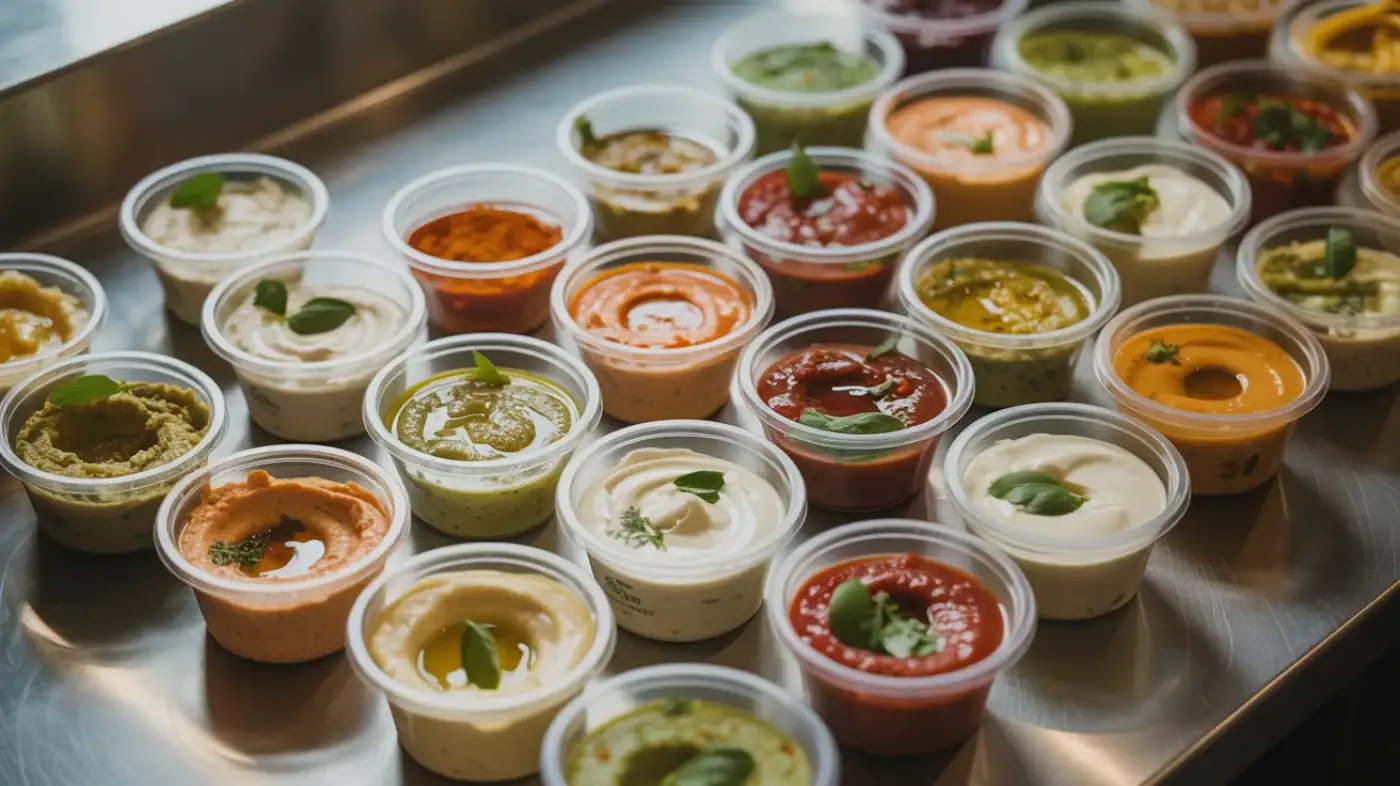
Pesto Filling Machine for Retail Cups and Foodservice Tubs
The SDH-R doses oil-rich basil pesto through large-bore valving, heat-seals a tamper-evident membrane and adds optional nitrogen MAP and snap-on lids in one rotary pass, at up to 30 cups per minute with ±0.5% fill accuracy.
A pesto filling machine is automatic equipment that doses pesto into pre-formed cups or tubs and seals them. The Hummus Pack SDH-R is a rotary pesto filling machine that fills 50-500 g at ±0.5% accuracy with a servo-driven volumetric piston, passes basil and pine nut through large-bore valving, heat-seals a roll-film membrane and adds optional nitrogen MAP and lids at up to 30 cups per minute (18-25 real-world), from $45,000 USD.
- Output
- Up to 30 cups/min (18-25 real-world)
- Fill range & accuracy
- 50-500 g, ±0.5% (servo volumetric piston)
- Cup sizes
- 4, 8, 10, 16 oz standard; 2-32 oz custom tooling
- Particulates
- Large-bore valving passes herbs and nut pieces
- MAP shelf life
- Residual O2 0.3-0.4%; ~7-10 to 30-45+ days refrigerated
- Build & compliance
- 304 stainless, CIP, tool-free strip-down; CE, FDA compliant, UL listed
- Price & lead time
- From $45,000 USD; 8-12 weeks; 12-month warranty
What Is a Pesto Filling Machine?
A pesto filling machine is automatic packaging equipment that doses pesto into pre-formed cups or tubs and seals them, without hand scooping. The Hummus Pack SDH-R rotary cup filling, sealing and lidding machine is the pesto filling machine we design and build in Calgary, Alberta, powered by Alter Pack, for producers of fresh refrigerated basil pesto, pesto rosso and plant-based pesto. It is engineered around what makes pesto difficult: an oil phase that separates the moment product stands still, leaf and nut particulates that small valves shear or bridge, and oil that contaminates the sealing flange.
On one rotary index the SDH-R denests a cup, fills 50 g to 500 g with a servo-driven volumetric piston held to ±0.5% fill-weight accuracy, adds up to two further components, heat-seals a tamper-evident roll-film membrane and, where specified, flushes nitrogen and applies a plastic lid. Rated output is up to 30 cups per minute on a dry cycle. With real pesto, expect 18 to 25 cups per minute depending on viscosity, cup size, fill weight and options, the range we quote up front because it is what you will see on your floor.
The SDH-R shares its platform with our dip filling and sealing machine range, but for pesto the valving bore, nozzle type, filler count, seal recipe and MAP option are chosen against your formulation. The machine is CE marked, FDA compliant and UL listed.
Oil Separation: Keeping Pesto Homogeneous From Buffer Tank to Piston
Pesto is an unstable suspension of basil, garlic, nut and cheese solids in oil. Left standing in a hopper, the oil rises and the solids settle. Because a volumetric piston meters volume, not mass, a shifting oil-to-solids ratio at the valve changes the weight in every cup: dense, solids-heavy cups while the bottom of the hopper drains, then light, oily cups as the run reaches the oil layer. The cure sits upstream of the servo-driven volumetric piston, not in the filler settings.
Use an agitated buffer tank, not a static hopper
Hold pesto in an agitated buffer tank between the batch mixer and the filler. Slow, low-shear agitation keeps oil and solids together without beating in air or bruising leaf, and the buffer feeds the filler hopper at a steady level so the piston always draws the same homogeneous mass. Our engineering team will ask about your transfer method, batch size and run length before quoting.
Three other causes of pesto fill drift
- Air entrainment. High-shear blending folds air into pesto, and a low hopper lets the piston draw air; both cause light fills and voids.
- Fill temperature. Pesto thins as it warms and stiffens as it cools, and olive oil can cloud and thicken at refrigerator temperatures, so fill at a consistent, specified temperature.
- Batch variation. Basil moisture and oil ratio change between harvests and suppliers. The optional weight checker with feedback loop corrects drift before it becomes giveaway or short weight.
Basil Pesto Filler Design for Leaf, Pine Nut and Hard Cheese
Genovese-style pesto carries basil leaf, pine nut pieces and grated Parmigiano or Pecorino, and many brands sell on that visible texture. A small-bore valve or nozzle shears leaf, smears nut into paste and lets grated cheese bridge the opening. Sheared basil darkens faster, and a pulverized nut fraction makes the pack look duller and grayer on shelf.
The SDH-R uses large-bore valving so herbs and nut pieces pass through rather than being cut, with nozzle and piston geometry sized to the largest particulate in your recipe. The same volumetric platform runs our hummus filling machine, where chickpea texture makes a similar demand. Before specifying a basil pesto filler we ask for:
- Largest particulate: pine nut halves or whole nuts, leaf cut size, cheese grate or shave.
- Viscosity at your real fill temperature.
- Target fill weight and cup, from 50 g up to 500 g.
- Any topping that must stay visible, which may suit the garnish filler rather than the base fill.
Cut-off or suck-back nozzle for pesto?
A suck-back nozzle pulls the tail of each shot back into the bore, the usual choice for oil-rich basil pesto that would otherwise drip a bead of oil onto the cup rim between indexes. A cut-off nozzle gives a positive mechanical break that suits stiffer, higher-solids recipes such as sun-dried tomato pesto.
Pesto Sealing Machine Performance: Oil on the Flange and Seal Parameters
Oil on the sealing flange is the single biggest cause of failed seals in pesto packing. A film of olive oil between the lidding film and the cup rim stops the sealant layer from fusing, leaving a channel leak that passes visual inspection and fails later in the cold chain. As an automatic cup sealing system, the SDH-R tackles flange contamination in two places: at the fill and at the seal head.
Keep the flange clean at the fill
Most oily flanges are created by the filling step. A controlled servo fill places product without splashing, a suck-back or cut-off nozzle stops strings and drips, and sensible headspace keeps product off the rim as the table indexes.
Set the pesto seal window
The SDH-R heat-seals a tamper-evident membrane cut from roll film. Seal temperature, pressure and dwell are set per recipe and stored on the HMI, so each pesto SKU recalls a window proven for its cup and film. The goal is a window wide enough to seal through a trace of oil without scorching film or distorting a thin-wall cup.
- Specify a lidding film whose sealant layer suits your cup material and oily products, and confirm it with your film supplier.
- Find the lowest temperature that seals consistently at production dwell, then add a margin rather than running hot.
- When seals fail on lightly oiled rims, look at pressure and dwell before raising temperature.
- Validate with peel and leak tests on product-filled cups, and repeat after any recipe, cup or film change.
Pre-die-cut lids are available where artwork or barrier specification requires them, and a snap-on plastic lid can go over the membrane for reclosability.
Get a configured SDH-R quote for your productSend your product, cup size and target cups per minute — we reply within 24 hours.
Request a quoteMAP Nitrogen Flushing to Slow Basil Browning and Extend Shelf Life
In many refrigerated basil pesto programs, color is the first quality attribute to go. Headspace oxygen drives the oxidative browning that turns a bright green surface olive-drab, and shoppers reject the cup long before its code expires. The optional nitrogen MAP flush on the SDH-R displaces headspace oxygen as the cup is closed: the container MAP system reduces residual oxygen to 0.3-0.4%, and typical refrigerated shelf life extends from roughly 7-10 days to 30-45 days or more, depending on the product.
What MAP can and cannot do for pesto
- It lowers headspace oxygen; it cannot remove air already beaten into the product during blending.
- It works alongside formulation levers such as blanched basil, antioxidants and an olive-oil surface layer, not instead of them.
- It supports, but never replaces, your cold chain, acidification and sanitation program.
Low-oxygen packaging of a refrigerated food is also a food-safety decision: establish MAP shelf life by testing and review it within your HACCP or FSMA Preventive Controls (21 CFR Part 117) food safety plan, ideally with a process authority. We supply nitrogen flushing as a MAP cup filler option; only your testing can set the date code on your label.
Pesto Filling Machine Problems vs SDH-R Features
This table maps common pesto line failure modes to the SDH-R feature or option that addresses each, as a checklist when comparing a pesto filling machine with hand-packing or a generic sauce filler.
Common pesto packaging problems and how the SDH-R addresses them
| Pesto problem | What goes wrong on the line | SDH-R feature or option |
|---|---|---|
| Oil separation | Heavy, then light, cups as the hopper separates | Agitated buffer feed; optional weight checker with feedback |
| Leaf and nut shear | Bruised basil and a pasty nut fraction | Large-bore valving sized to your largest particulate |
| Drips and strings | Oil bead on the cup rim between indexes | Suck-back (drip-free) or cut-off nozzle; controlled servo fill |
| Oily sealing flange | Channel leaks that fail in the cold chain | Membrane heat seal with temperature, pressure and dwell stored per recipe |
| Basil browning | Olive-drab surface before the end of code | Optional nitrogen MAP to 0.3-0.4% residual oxygen |
| Allergen cross-contact | Tree nut or milk carryover into a vegan SKU | 304 stainless, CIP capability, tool-free strip-down |
| Many SKUs and formats | Long changeovers between recipes and cups | Changeover under ~15 minutes; stored HMI recipes |
| Premium topped SKUs | Hand garnishing adds labor | Up to 3 fillers in one pass: base, drizzle, garnish |
Running Pesto Recipe Variants: Genovese, Sun-Dried Tomato, Vegan and Kale or Arugula
Few pesto producers run a single recipe. The SDH-R handles variants through stored HMI recipes, nozzle choice and up to three filling stations rather than a separate machine per product.
How common pesto recipes behave on the SDH-R
| Recipe | Filling behavior | Configuration notes |
|---|---|---|
| Genovese basil (pine nut, hard cheese, olive oil) | Oil-rich, separates quickly, visible leaf and nut | Agitated buffer, large-bore valving, suck-back nozzle, MAP for color |
| Sun-dried tomato (pesto rosso) | Thicker, higher solids, stickier tomato pieces | Cut-off nozzle; valving sized for tomato pieces |
| Vegan or nut-free | No cheese or tree nuts; binders and oil ratio vary | Run first in the allergen sequence; check any seeds for sesame |
| Kale or arugula (often with walnut) | Fibrous leaf strands that can wrap or bridge | Control leaf cut at the batch step; tree-nut changeover if walnut is used |
Layered and topped pesto in one pass
Up to three fillers run in sequence on one index: a base fill of basil pesto, an olive-oil drizzle from the optional peristaltic pump to protect the surface, then a garnish filler placing toasted pine nuts or shaved hard cheese, or a second paste fill such as a swirl of pesto rosso. A topped SKU then costs no more labor per cup than a plain one. Our guide to multi-component filling for layered dips covers station sequencing in more detail.
Allergen Changeover and CIP for Tree-Nut and Dairy Pesto
Pesto is among the most allergen-dense products in a refrigerated dip room. Traditional recipes carry tree nuts (pine nuts, sometimes cashews or walnuts) and milk from hard cheese. Both are major food allergens under the US Food Allergen Labeling and Consumer Protection Act (FALCPA) and priority allergens in Canada, where license holders under the Safe Food for Canadians Regulations (SFCR) must address allergen cross-contact in their preventive control plan. If a nut-free recipe uses seeds, check for sesame, which became the ninth major US allergen on January 1, 2023 under the FASTER Act.
A practical pesto allergen changeover sequence
- Run allergen-free recipes such as vegan nut-free pesto first after a full sanitation, then dairy-only recipes, then tree-nut-and-dairy recipes.
- At the allergen break, strip down the hopper, piston, valving and nozzles without tools.
- Wet clean to your validated sanitation procedure, using the optional CIP system where it is specified.
- Verify with allergen-specific test kits; ATP swabs indicate general hygiene but do not detect allergen protein.
- Swap and reconcile lidding film, labels and coding data, because a wrong label is a common route to an undeclared-allergen recall.
- Recall the next SKU's stored recipe on the HMI and restart.
Recipe recall keeps the settings changeover under about 15 minutes; validated wet-clean time is additional. The SDH-R's 304 stainless construction, CIP capability and tool-free strip-down are designed to support plants operating under HACCP, BRCGS, SQF and FSMA Preventive Controls, which audit your plant's program rather than the machine. Our pesto filling application guide shows how the platform is applied across the category.
Pesto Cup and Tub Filling: 4, 6 and 8 oz Retail Cups vs Foodservice Tubs
One producer may run a 4 oz sampler, a 6 or 8 oz retail cup and a 16 oz foodservice tub, so a pesto cup filling machine must change formats quickly. On the SDH-R, 4, 8, 10 and 16 oz cups are standard; sizes from 2 oz to 32 oz, including 6 oz, run with matching custom tooling (change parts) in round, square or rectangular shapes. A pneumatic denester feeds pre-formed cups and tubs; the machine does not thermoform them.
Pesto cup and tub formats on the SDH-R
| Format | Typical channel | SDH-R tooling and notes |
|---|---|---|
| 2 oz | Portion cups, meal kits, sampling | Custom tooling; at the 50 g minimum fill |
| 4 oz | Single-serve, deli grab-and-go | Standard |
| 6 oz | Retail grocery tub | Custom tooling |
| 8 oz | Retail and value packs | Standard |
| 16 oz | Club packs and foodservice tubs | Standard; near the 500 g top of the fill range |
| 32 oz | Bulk foodservice | Custom tooling; fills above 500 g need engineering confirmation |
Retail vs foodservice pesto tub filling
Retail pesto sells on a bright green surface, a clean tamper-evident membrane, accurate net weight and enough shelf life for distribution, which is where MAP and garnish stations earn their place. Foodservice tubs prioritize yield, a reclosable lid and fast changeover. Note that a 6 oz net weight pesto may need a larger cup to leave headspace for a clean seal. Fills below 50 g, such as 1 oz dipping cups, are outside the standard range; see our portion cup filling machine page.
Pesto Packaging Machine Line Layout: Batch, Buffer, SDH-R, Labeling and Coding
A pesto packaging machine performs only as well as the line around it. A typical fresh refrigerated pesto line runs in this order:
- Batch. Blend with controlled leaf cut and minimal air, then bring to the specified fill temperature.
- Transfer. Use a low-shear method that does not bruise leaf or re-separate the oil.
- Agitated buffer tank. Keep oil and solids homogeneous and feed the filler hopper at a constant level.
- SDH-R. Denesting, base fill, optional drizzle and garnish, membrane sealing, optional nitrogen MAP and lid, then discharge.
- Weight check. The optional weight checker with feedback loop trims the fill as batches change.
- Labeling and coding. Optional top and side labeling and variable data coding for lot and use-by date.
- Case packing and cold storage. Move sealed cups into refrigeration promptly.
The SDH-R occupies 44 × 52 in (1,100.5 × 1,315.5 mm) and stands 65.6 in high, so the buffer tank, conveyor and labeler usually set the room layout; a discharging conveyor extension is available. When you share your product, cup size and target cups per minute with our engineering team, include room dimensions and we can suggest a layout.
Pesto Filling Machine Price, ROI and When the SDH-R Is Not the Right Fit
The SDH-R pesto filling machine starts from $45,000 USD in its single-filler configuration. Price scales with additional fillers, MAP, labeling and coding, the weight checker and custom tooling. Delivery is 8-12 weeks from order confirmation, with a 12-month warranty and service centers in Alberta, New Jersey and California.
Where the return on a pesto filling machine comes from
- Giveaway. ±0.5% fill accuracy lets you target close to declared weight instead of overfilling.
- Labor. One rotary pass replaces hand scooping, rim wiping, sealing and lidding.
- Seal integrity. Clean flanges and stored seal recipes reduce leakers, returns and write-offs.
- Shelf life and SKU range. MAP dating of 30-45+ days (product-dependent) and changeovers under about 15 minutes make wider distribution and short premium runs practical.
As illustrative arithmetic, not a customer result: overfilling a 200 g cup by 3% gives away 6 g per cup. At 20 cups per minute over a 7-hour run, that is 8,400 cups and roughly 50 kg of pesto per shift, while ±0.5% on the same cup is a window of about ±1 g. Run your own numbers, then request a pesto filling machine quote configured for your product.
When the SDH-R is not the right pesto packaging machine
- Single-SKU volume above 30 cups per minute: an inline cup filling machine line is the better fit.
- Shelf-stable pesto in glass jars: the SDH-R is not a jar filler, nor an aseptic or retort system.
- Frozen pesto, fills below 50 g, pouches or thermoformed packs: all outside its scope.
Pesto Filling Machine Quote Preparation: What to Measure in 2026
The most useful thing you can bring to a pesto filling machine quote is a short set of measurements from your own kitchen. Pesto varies widely between recipes, so a few facts about oil content, particle size and fill temperature let us specify the SDH-R correctly the first time.
Pesto measurements to gather and what they decide
| Measurement | What it decides |
|---|---|
| Fill temperature at the buffer tank | Whether the product stays pumpable and safe for a fresh refrigerated cup |
| Largest particle size (nut, leaf, tomato) | Valve bore and nozzle choice |
| Oil layer after 30 minutes standing | How much agitation the buffer tank needs |
| Target fill weight, 50 g to 500 g | Cup size and piston stroke |
| Top layer needed (oil cap) | Whether a second filler or peristaltic pump is added |
| Shelf life target | Whether nitrogen MAP is included |
The oil separation test is worth doing on a sample before the call. Leave a jar of finished pesto on the bench and note how quickly oil rises, because fast separation tells us the buffer tank and piston feed need to be designed to keep the batch uniform. Our page on the piston filling machine explains how the volumetric filler delivers ±0.5% accuracy once the product reaches it consistently.
- Record the recipe variants you plan to run, including any tree-nut and nut-free versions.
- Note whether the cups will carry a membrane seal, a snap-on lid or both.
- Decide if labeling and variable data coding will be integrated on the same line.
- Confirm the footprint available: the machine occupies 44 by 52 inches, 65.6 inches tall.
Send these notes through the contact page. The team may ask follow-up questions about your application and replies within about 24 hours. If your pesto falls outside what a fresh, refrigerated, pumpable cup process can handle, we will say so before you spend time on a quote.
Pesto Filling Machine — Frequently Asked Questions
The Hummus Pack SDH-R pesto filling machine starts from $45,000 USD for the single-filler configuration. Price rises with extra filling stations (up to three), nitrogen MAP, lidding, labeling and coding, a weight checker and custom cup tooling, and each machine carries a 12-month warranty. Our guide to cup filler and sealer costs explains how options affect price.
The SDH-R pesto filling machine is rated up to 30 cups per minute on a dry cycle. With real pesto, output is typically 18-25 cups per minute depending on viscosity, particulates, cup size, fill weight and options; nut-heavy recipes and 16 oz tubs sit toward the lower end. Producers needing more than 30 cups per minute on one SKU should consider an inline line.
Yes. The SDH-R uses large-bore valving and a servo-driven volumetric piston sized against your largest particulate, so basil leaf, pine nut pieces and grated hard cheese pass through rather than being sheared or bridging the nozzle. Whole nuts or visible toppings can go through the optional garnish filler instead, and our engineering team confirms geometry against your recipe before quoting.
Pesto oil separation is controlled upstream of the filler. Hold the product in an agitated buffer tank so oil and solids stay together, feed the SDH-R hopper at a constant level and fill at a consistent temperature. The servo-driven volumetric piston then repeats ±0.5% fill accuracy on a homogeneous product, and the optional weight checker with feedback loop corrects drift between batches.
On the SDH-R, the optional nitrogen MAP flush reduces residual headspace oxygen to 0.3-0.4%, which slows the oxidation that browns basil pesto. Typical refrigerated shelf life extends from roughly 7-10 days to 30-45 days or more, product-dependent, and your own shelf-life testing must set the final date code. See our guide to MAP nitrogen flushing and dip shelf life.
Most pesto seal failures come from olive oil on the cup flange, which stops the heat-seal layer fusing and creates channel leaks that appear later in the cold chain. The SDH-R prevents this with a controlled servo fill, a suck-back or cut-off nozzle that stops drips, and a membrane seal whose temperature, pressure and dwell are stored per recipe on the HMI.
The SDH-R is built from food-grade 304 stainless steel with CIP capability and tool-free strip-down, so the hopper, piston, valving and nozzles come apart for a full wet clean without tools. Run nut-free pesto first and verify cleans with allergen-specific test kits. Recipe recall keeps the settings changeover under about 15 minutes; validated wet-clean time is additional.
The SDH-R fills 4, 8, 10 and 16 oz pesto cups as standard, and cups from 2 oz to 32 oz, including the 6 oz retail size, with matching custom tooling. Round, square and rectangular cups are supported. The standard fill range is 50-500 g at ±0.5% accuracy, so fills above 500 g or below 50 g should be confirmed with our engineering team.
The Hummus Pack SDH-R is designed and built in Calgary, Alberta, Canada, and ships 8-12 weeks from order confirmation with a 12-month warranty. Service is supported from our centers in Alberta, New Jersey and California. To quote, send your product, cup size, target cups per minute and options; we typically reply within about 24 hours.
Related machines & guides
Explore the pages most relevant to this application.
Why producers buy from Hummus Pack
Ready to Quote Your Pesto Filling Machine?
Get a personalized SDH-R configuration and price for your product, cup sizes, and production volume.