
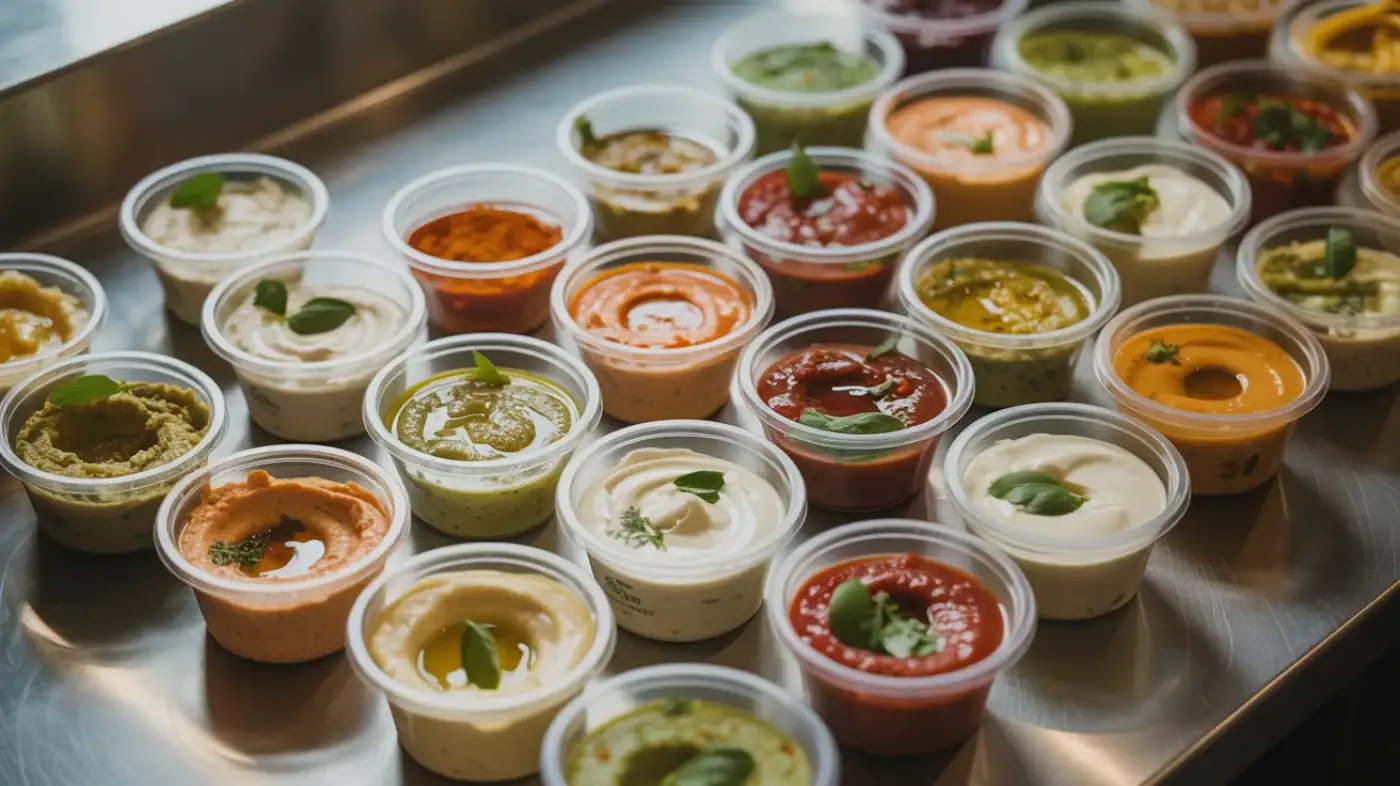
Salsa Cup Packaging: Chunks, Juice & Seals
From chunky pico de gallo to smooth hot sauces — the SDH-R fills acidic and particulate-laden sauces into retail cups with precise portion control.
Salsa, hot sauce, queso, and condiment producers face unique packaging challenges: acidic products that corrode lesser materials, chunky textures with tomato, onion, and pepper pieces that clog conventional fillers, and a wide range of viscosities from thin hot sauces to thick queso dips. The SDH-R's 304 stainless steel construction resists acid corrosion, while the servo piston's adjustable flow rate handles everything from smooth sriracha to chunky restaurant-style salsa.
Why Salsa & Sauce Producers Choose the SDH-R
Acid-Resistant Construction
304 stainless steel product-contact surfaces resist corrosion from tomato, citrus, and vinegar-based products. No flavour transfer between batches.
Chunk-Friendly Filling
The servo piston fills chunky salsa with diced tomatoes, onions, peppers, and cilantro without jamming. Adjustable port size accommodates particle sizes up to 15mm.
Hot-Fill Capability
For hot sauces and salsas requiring hot-fill pasteurization, the SDH-R handles product temperatures up to 85°C (185°F) with appropriate sealing film selection.
Multi-Pack Efficiency
Package snack-size 2oz cups, standard 8oz retail jars, and 16oz family-size containers on the same machine with quick tooling changes.
SDH-R Configuration for Salsa & Sauces
Products We Fill
Available In These Markets
How the SDH-R Fills Salsa & Sauces
Fully automatic process from empty cup to sealed product — no manual labour required
Cup Denesting
Empty cups are automatically separated from a nested stack and placed into the rotary table carriers. The pneumatic denester handles round, square, and rectangular cups from 2oz to 32oz — ideal for the standard salsa & sauces cup formats your customers expect.
Servo-Driven Filling
The volumetric piston filler draws a precise dose of salsa & sauces and dispenses it into the cup. Servo control adjusts stroke length and speed per recipe, maintaining ±0.5% fill-weight accuracy across production runs. The PLC stores recipes for quick changeovers between product variants.
Membrane Heat Sealing
Roll-stock film is drawn across the filled cup and heat-sealed to create a tamper-evident, airtight membrane. Sealing temperature, pressure, and dwell time are individually controlled to match your specific film and cup material combination.
Snap-On Lid (Optional)
A pick-and-place mechanism applies a consumer-friendly snap-on plastic lid over the membrane seal. This two-barrier system provides both tamper evidence and reclosability — the standard expected by grocery retailers and foodservice distributors.
MAP Nitrogen Flush (Optional)
Modified Atmosphere Packaging replaces oxygen in the headspace with food-grade nitrogen immediately before sealing. For salsa & sauces, this typically extends refrigerated shelf life from 7–10 days to 30–45+ days — a requirement for most retail distribution channels.
Salsa Cup Packaging: Managing Chunks, Free Liquid and Acidity
Fresh salsa behaves like two products sharing one cup: a particulate phase of diced tomato, onion, pepper and cilantro, and a free-liquid phase of tomato juice, lime juice or vinegar. Left standing in a hopper, the two separate within minutes, so a piston can draw a juice-heavy dose followed by a chunk-heavy one. The cups still meet weight, but they look inconsistent on the shelf, and the extra juice is what splashes onto the flange. Draining diced vegetables before mixing, mixing gently in the batch tank and refilling the hopper little and often keep the feed uniform.
Matching the filler to the salsa style
Salsa styles and the SDH-R configuration that suits each
| Salsa style | Main line challenge | Configuration approach |
|---|---|---|
| Pico de gallo and chunky refrigerated salsa | Large dice, free juice, crushed pieces | Large-bore valving and a slower piston stroke; maximum dice size confirmed from your recipe |
| Blended salsa and salsa verde | Low viscosity, drips between cups | Suck-back (drip-free) nozzle |
| Thin taco and hot sauce cups | Very thin, splash-prone liquid | Peristaltic pump evaluated for the specific sauce |
| Salsa con queso and cheese dips | Thick body, milk allergen | Servo piston; scheduled after milk-free salsas |
| Salsa with a cilantro or cheese topping | Topping placement away from the flange | Garnish filler on the third station |
Keeping the seal area clean
- Suck-back nozzles pull back the last drop of juice so it does not fall on the cup rim while the turret indexes.
- Leave enough headspace that juice does not slosh onto the flange as the cup moves between stations.
- Store seal temperature, pressure and dwell with each recipe so a film or cup change does not depend on operator memory.
- Check seals at the start of every run and after each recipe change.
Acidity is mostly a materials question. Product-contact parts on the SDH-R are food-grade 304 stainless steel; share your recipe's acid and salt levels when you request a quote so our engineers can confirm material and seal selection for your product. Most tomato salsas carry no major allergens, so run them first in the day, ahead of queso or crema-based dips that contain milk.
Be clear about the process you are running. The SDH-R fills and seals pre-formed cups of fresh, refrigerated salsa at a pumpable temperature. Shelf-stable salsa packed in glass jars by hot-fill or retort is a different process on a different line. If your cooked salsa goes into cups warm, fill temperature, cup material and film are confirmed with our engineering team before we quote.
For refrigerated cups, nitrogen MAP lowers residual oxygen to 0.3-0.4%, which helps protect the color of cilantro and the fresh flavor of onion; how much shelf life it adds depends on acidity, salt, starting microbial load and cold-chain discipline, so validate it with a shelf-life study. Our article on salsa, sauce and guacamole cup filling compares the three products side by side, and the queso and cheese dip filling machine page covers dairy-based dips.
When you are ready to evaluate equipment, our dedicated salsa filling machine page covers SDH-R configurations, pricing and lead time, or you can send us your salsa details, cup size and target output for a configuration review.
Salsa Cup Packaging — Frequently Asked Questions
Free juice on the flange is the most common cause of weak seals on salsa cups. On the Hummus Pack SDH-R, a suck-back nozzle stops drips between cups, the fill height leaves headspace so juice does not slosh during indexing, and seal temperature, pressure and dwell are stored per recipe. Upstream, draining diced vegetables before mixing reduces the free liquid that reaches the cup in the first place.
It depends on the valve and nozzle bore rather than the machine as a whole. The Hummus Pack SDH-R uses large-bore valving to pass particulates such as diced tomato, onion and pepper, combined with a slower servo piston stroke to avoid crushing them. Because dice size and firmness vary by recipe, our engineering team confirms the maximum particle size for your salsa from your recipe details before quoting.
Yes. Salsa and guacamole can run on the same Hummus Pack SDH-R, with recipe changeover in under about 15 minutes through stored PLC settings and tool-free parts. Guacamole usually benefits more from the optional nitrogen MAP flush because avocado browns quickly when exposed to oxygen. If either product contains milk or another allergen, complete a validated clean between them. See our guacamole packaging guide for avocado-specific handling.
Refrigerated salsa is commonly sold in 8 oz and 16 oz tubs, with 2 oz cups used for snack packs, meal kits and foodservice sides. The SDH-R runs 4, 8, 10 and 16 oz cups as standard and custom cups from 2 to 32 oz with matching tooling, within a 50-500 g fill range. Note that 2 oz cups sit at the low end of that range, and 1 oz cups fall outside it.
No. The Hummus Pack SDH-R is designed for fresh and refrigerated products filled into pre-formed cups at a pumpable temperature and sealed with membrane film. Shelf-stable salsa sold at ambient temperature is typically packed in glass jars by hot-fill or retort processes on dedicated jar lines, which the SDH-R is not. If your cooked salsa is filled warm into cups, our engineers confirm fill temperature, cup and film compatibility before quoting.
Shelf life depends on the recipe, acidity, salt, starting microbial load and cold chain, so it must be validated for each product. Nitrogen MAP on the SDH-R lowers residual oxygen in the cup to 0.3-0.4%, and for refrigerated dips this typically extends shelf life from roughly 7-10 days to 30-45+ days. Treat those figures as a starting point for your own shelf-life study. Our MAP shelf-life guide explains the variables.
Ready to Package Salsa & Sauces?
Get a personalized SDH-R configuration quote for your product and production volume.