
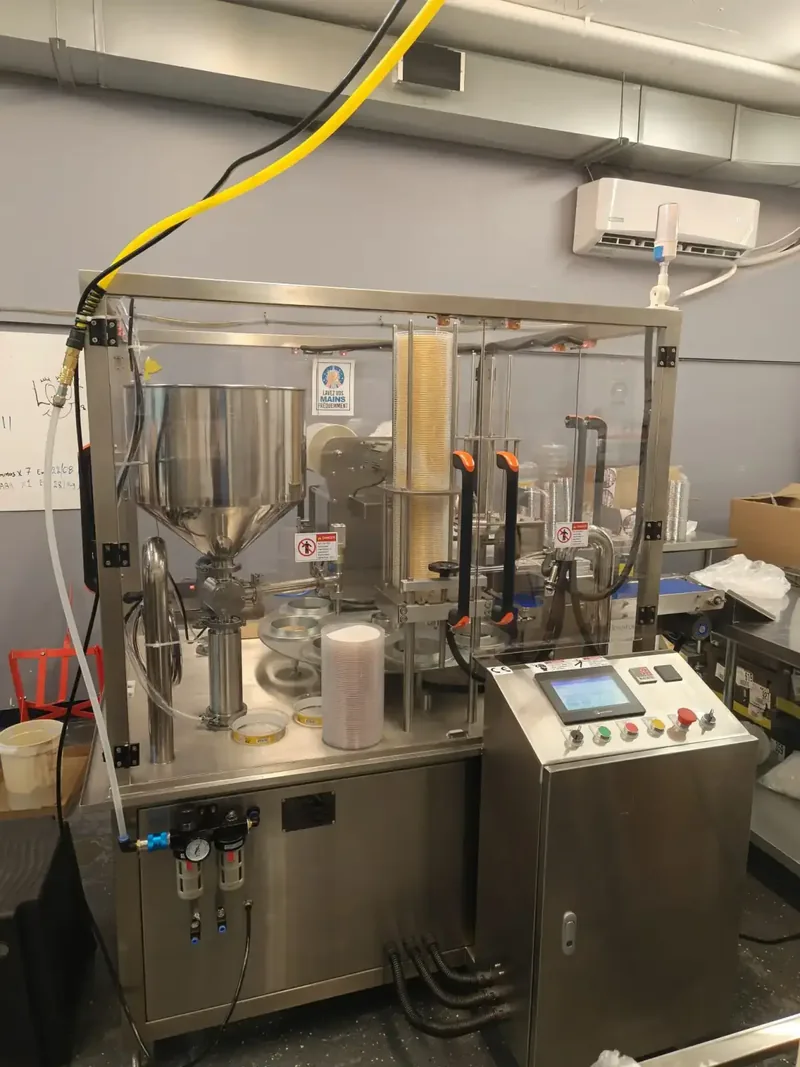
Small Batch Filling Machine for Food Startups & Small Businesses
Move from hand filling to a compact, fully automatic cup filler and sealer. The Calgary-built SDH-R doses 50–500 g at ±0.5% on a 44 × 52 in footprint and switches between SKUs in under about 15 minutes.
A small batch filling machine is a compact filler sized for producers who run short batches of several recipes instead of one product all day. Hummus Pack's SDH-R is a fully automatic rotary option for food startups: it fills and heat-seals pre-formed 50–500 g cups at ±0.5% accuracy, about 18–25 cups a minute in real production, on a 44 × 52 in footprint, starting at $45,000 USD.
- Starting price
- From $45,000 USD (single-filler configuration)
- Footprint
- 44 × 52 in (1,100.5 × 1,315.5 mm); height 65.6 in (1,666 mm)
- Output
- 18–25 cups/min real-world; up to 30 on a dry cycle
- Fill range and accuracy
- 50 g – 500 g, ±0.5% (servo-driven volumetric piston)
- SKU changeover
- Under ~15 minutes, with recipe storage on the HMI
- Delivery and warranty
- 8–12 weeks from order confirmation; 12-month warranty
- Made in
- Calgary, Alberta, Canada
What Is a Small Batch Filling Machine?
A small batch filling machine is a cup filler built for producers who make short runs across several recipes rather than one product around the clock. For a food startup it is the step between scooping by hand and buying a full packaging line: one compact frame that doses, seals and discharges finished cups while a small crew keeps it supplied.
Our answer to that brief is the SDH-R, a fully automatic rotary machine that fills and seals cups and is built in Calgary, Alberta. Compact does not mean simplified: it doses with a servo-driven volumetric piston, heat-seals film cut from a roll and runs from a PLC with an HMI.
It handles pre-formed cups and tubs holding 50 g to 500 g of fresh or refrigerated product that pumps at your filling temperature, from hummus and salsa to pesto, nut butters and plant-based dips. It does not fill pouches, bottles or jars, it is neither aseptic nor a retort system, and we do not claim a hot-fill rating. Still planning the company? See our guide on starting a hummus business.
Signs Your Food Startup Has Outgrown Hand Filling
Founders feel the ceiling before they measure it. Producers asking us about a filling machine for small business use usually describe these signals:
- Labor hours climb with every order. If doubling cases means doubling the people at the fill table, cost per cup never falls.
- Fill weights wander. Hand-scooped hummus traps air and varies by technique, so the team overfills to stay above label weight.
- Sealing sets the pace. A single-cup heat sealer becomes the bottleneck while filled cups wait open on the bench.
- A buyer wants a volume commitment. A regional chain or distributor asks for weekly cases you cannot promise without hiring.
- Seal failures come back to you. Leakers and lifted film often trace to product on the flange or uneven heat, pressure and dwell time at the sealer.
Measure before you shop
Spend one production day collecting three numbers: labor hours per 1,000 finished cups, average net weight against declared weight on cups pulled across the run, and the share of cups reworked or scrapped. Those figures drive the payback math below and give our engineers something to size against.
Why a Compact Rotary Small Batch Filling Machine Suits Small Plants
Inline lines stretch stations along a conveyor, which takes length a startup unit rarely has. A rotary cup filling machine arranges them around an indexing dial, so denesting, dosing, sealing and optional lidding happen inside one frame. On the SDH-R that frame measures 44 × 52 in, just under 16 square feet of floor, and stands 65.6 in tall.
- A small crew runs it. People load nested cups into the pneumatic denester, change film rolls, feed the hopper and pack sealed cups; we size staffing with you rather than promise a headcount.
- Recipes live on the HMI. Each SKU's settings are saved as a recipe, so a five-flavor range does not depend on one person's notebook.
- Changeover is short. A SKU switch needs under about 15 minutes, which matters more than top speed when you run three flavors before lunch.
- Toppings stop being a hand step. With up to three fillers in one pass, an olive oil drizzle from a peristaltic pump or pine nuts from the garnish filler land on every cup the same way.
On capacity, the SDH-R's dry-cycle ceiling is 30 cups per minute, and real production usually lands between 18 and 25 depending on product, cup and options. That is roughly 1,100 to 1,500 cups an hour, so a small producer can run in short, planned blocks.
Hand Fill, Semi-Automatic, SDH-R or Inline: Matching the Machine to Your Stage
No single food startup filling machine is right at every stage. The table maps stages of growth to the option we would recommend, including ones we do not sell.
Stage of business vs best-fit cup filling option (qualitative guide)
| Stage of business | Typical situation | Best-fit option | Why it fits |
|---|---|---|---|
| Recipe testing, farmers markets | Recipes and cups still changing | Hand filling, bench scale, manual sealer | Lowest capital; flexibility beats speed |
| First local retail accounts | Steady orders on one or two SKUs; labor manageable | Semi-automatic filler plus bench sealer | Powered dosing tightens weights at modest cost |
| Regional retail, several SKUs | Labor, giveaway or seal failures limit growth | SDH-R fully automatic rotary filler and sealer | Doses, seals and optionally lids in one pass; changeover under ~15 minutes |
| National programs, one dominant SKU | Demand well beyond 30 cups per minute on one product | Inline cup filling line | Multi-lane inline equipment scales past one rotary dial |
Between rows two and three, our semi-automatic vs automatic comparison goes deeper, and the inline cup filling machine page covers the high-volume end. Some brands hire a co-packer first; see co-packer vs in-house production.
Get a configured SDH-R quote for your productSend your product, cup size and target cups per minute — we reply within 24 hours.
Request a quoteWhen Hand Filling or a Semi-Automatic Sealer Is Still the Right Call
We would rather lose a sale than sell a machine that sits idle. Keep filling by hand, or buy a semi-automatic filler and bench sealer elsewhere, when:
- A small team fills and seals your weekly volume comfortably without overtime.
- The recipe, cup or brand still changes month to month, so tooling would be wasted.
- Your portion is under 50 g (a 1 oz sample cup, for example), which sits outside the SDH-R standard range.
- Your product goes into jars, bottles, pouches or sachets rather than pre-formed cups or tubs.
- Your process depends on hot fill, aseptic packing or retort, none of which the SDH-R is built for.
Food Packaging Machine for Small Business: Honest Price and Payback Math
The SDH-R starts at $45,000 USD with a single filler. Extra fillers, nitrogen MAP, labeling or custom cup tooling raise the price. Our article on what a cup filling and sealing machine costs breaks those drivers down.
We publish no wage rates or savings benchmarks; plug your own measurements into this outline:
- Hours saved (H): labor hours per 1,000 cups now, less expected hours with the machine, times thousands of cups sold per year.
- Labor value (L): H times your fully loaded hourly cost.
- Giveaway recovered (G): cups per year × (current overfill in grams minus planned overfill with ±0.5% dosing) ÷ 1,000 × ingredient cost per kilogram.
- Rejects avoided (R): cups no longer scrapped for leaks or weight, times product, cup and film cost.
- Running costs (C): film, lids, nitrogen, power, air, maintenance and cleaning.
- Payback in years: installed cost ÷ (L + G + R − C).
For step 3, take a hypothetical 227 g (8 oz) cup: ±0.5% is about 1.1 g either way. Hand fillers may aim several grams over label; every gram between today's aim and what your quality team can safely hold with servo dosing stops being given away. Your QA lead sets that target under the applicable rules: in the US, 21 CFR 101.7(q) says variations from stated net quantity must not be unreasonably large, and in Canada the CFIA's net quantity guidance points to tolerances in the Safe Food for Canadians Regulations.
Our filling machine capacity sizing guide shows how to turn weekly orders into the cups per minute you actually need.
Small Cup Filling Machine Utilities and Site Prep
Small installations are more often delayed by the building than the machine. Use the eight to twelve weeks before delivery to settle these with our engineers and your landlord:
- Compressed air. The cup denester is pneumatic, so you need clean, dry air at the pressure and flow our engineers specify. Filtration near open product is a food safety plan decision.
- Nitrogen, only if you choose MAP. Once we confirm usage for your cup and rate, your gas supplier can advise on supply format.
- Electrical. Our engineering team confirms voltage, phase and current for your configuration in the quote; have an electrician check your panel.
- Access and floor space. Check doors and ceiling height along the delivery route against the 44 × 52 in base and 65.6 in height, plus room to load cups and film and strip parts.
- Washdown and drainage. Parts strip down without tools and CIP is optional, which shortens cleaning, but you still need a wash area and compliant drainage.
Commercial Kitchens, Incubators and Shared Food Facilities
Many startups begin in a shared commercial kitchen or food incubator. An automatic filler can work there, but the facility sets the rules, so confirm with the operator:
- Whether equipment may stay in place between your production slots.
- Compressed air, electrical capacity and nitrogen storage if you use MAP.
- How allergens are cleaned between tenants, especially sesame, which US law has treated as a major food allergen since January 1, 2023.
- Who holds the facility registration or licence, and how your records fit into it.
Size also changes which US rules apply. Under 21 CFR 117.3, a business averaging under $1,000,000 a year (adjusted for inflation) in human food sales, plus market value of food held without sale, over the prior three years is a very small business and therefore a qualified facility. Those follow the modified requirements in 21 CFR 117.201, built around attestations to FDA, rather than full preventive controls; good manufacturing practice rules still apply.
In Canada, the CFIA lists making or packaging food for interprovincial trade or export among the activities that require a Safe Food for Canadians licence; food made and sold within one province generally does not need one, though provincial rules may apply. A new account across a provincial border can change that. See our guide to writing a HACCP plan for dips, sauces and spreads.
Cup Sealing Machine for Small Business: Many SKUs, Many Formats
A startup week might bring classic hummus, roasted red pepper hummus and a spicy salsa, each in two cup sizes. The SDH-R takes standard 4, 8, 10 and 16 oz cups plus custom 2 to 32 oz sizes with matching change parts, and cup shape can be round, square or rectangular. Two-ounce cups sit at the bottom of the standard range, and the portion cup filling machine page covers that format.
How your product shapes the configuration
- Thick, aerated pastes such as hummus and nut butters: a volumetric piston doses by volume, so steady batch density keeps weight in tolerance.
- Chunky products such as salsa and guacamole: wide-bore valving passes pieces, and suck-back nozzles keep drips off the sealing flange.
- Products that weep or separate, like tzatziki releasing whey or pesto shedding oil: hold product temperature steady so viscosity, and the dose, stays consistent.
- Warm or very stiff products: with no hot-fill rating claimed, our engineers check fill temperature and viscosity extremes before quoting.
For longer code dates, optional nitrogen flushing brings residual oxygen down to 0.3–0.4%, and chilled shelf life that might be 7–10 days can stretch to 30–45+ days depending on the recipe, which can open regional distribution. Read about nitrogen flushing and dip shelf life.
Requesting a Quote for a Small Batch Filling Machine
Tell us the product, your cup size, the cups per minute you are aiming for and options you are weighing, such as MAP or a second filler. We may ask about the application first and aim to answer within about 24 hours. Start on our contact page, or reach sales@hummuspack.com or +1 (888) 922-7271 on weekdays, 9 AM to 5 PM MDT.
Every SDH-R is made in Canada, carries a 12-month warranty and is supported from our service centres in New Jersey, California and Alberta. When your numbers show hand filling is holding you back, ask us to size an SDH-R against your product and cup.
Sources and review
Every SDH-R figure on this page is checked line by line against the SDH-R engineering specification, as set out in our editorial policy. The regulatory and food-safety notes rely on these official sources, which we checked when this page was last updated:
- eCFR: 21 CFR 117.3, definitions of qualified facility and very small business
- eCFR: 21 CFR 117.201, modified requirements for a qualified facility
- eCFR: 21 CFR 101.7, declaration of net quantity of contents
- CFIA: Food business activities that require a licence under the SFCR
- CFIA: Net quantity on food labels
Regulatory information here is general guidance, not legal advice; confirm your obligations with the authority or a qualified advisor. Spotted something out of date? Email sales@hummuspack.com or call +1 (888) 922-7271.
Small Batch Filling Machine — Frequently Asked Questions
A small batch filling machine is a compact filler sized for short batches of several recipes rather than one product all day. Hummus Pack's SDH-R is a fully automatic rotary version that fills and heat-seals pre-formed 50–500 g cups at ±0.5% accuracy, about 18–25 cups per minute in real production, on a 44 × 52 in footprint.
The Hummus Pack SDH-R starts at $45,000 USD in its single-filler configuration. Extra fillers, nitrogen MAP, labeling and custom cup tooling raise the price. Payback depends on your own labor hours, giveaway and reject rates: measure them over a production day, then divide installed cost by the annual net saving.
Not necessarily. The SDH-R covers 44 × 52 in of floor, stands 65.6 in tall and is run by a small crew. At 18–25 cups per minute in real production, a startup can run it in short planned blocks. At very low volumes, hand filling or a semi-automatic filler may still be the smarter purchase.
Automate when hand filling limits growth: labor rises in step with orders, weights drift so you overfill, the sealer is the bottleneck, seal failures reach customers, or a buyer wants volume you cannot promise. The Hummus Pack SDH-R answers with ±0.5% servo dosing and film sealing in one pass; compare options on our semi-automatic vs automatic page.
Often, but the facility decides. Confirm that equipment can stay in place, that compressed air, power and nitrogen for MAP are available, and how allergen cleaning between tenants works. The SDH-R's 44 × 52 in footprint and changeover under about 15 minutes help in shared space.
Each product's settings are stored as a recipe on the SDH-R's HMI, and a product change needs under about 15 minutes. Standard cups are 4, 8, 10 and 16 oz, with custom 2–32 oz tooling, and up to three fillers add drizzles or garnishes in one pass. Allergen cleaning between SKUs remains your validated plant procedure.
The SDH-R fills pre-formed cups and tubs only, so pouches, bottles, jars and sachets need other equipment. Fills under 50 g are outside its standard range. It is not aseptic, retort or for frozen products, and we do not claim a hot-fill rating, so our engineers review fill temperature and viscosity extremes before quoting.
The Hummus Pack SDH-R is built in Calgary, Alberta, ships 8–12 weeks after the order is confirmed and is covered by a 12-month warranty. Our New Jersey, California and Alberta service centres support American and Canadian customers. Email sales@hummuspack.com with the product, cup and rate you need; expect an answer within about 24 hours.
Related machines & guides
Explore the pages most relevant to this application.
Why producers buy from Hummus Pack
Ready to Quote Your Small Batch Filling Machine?
Get a personalized SDH-R configuration and price for your product, cup sizes, and production volume.