
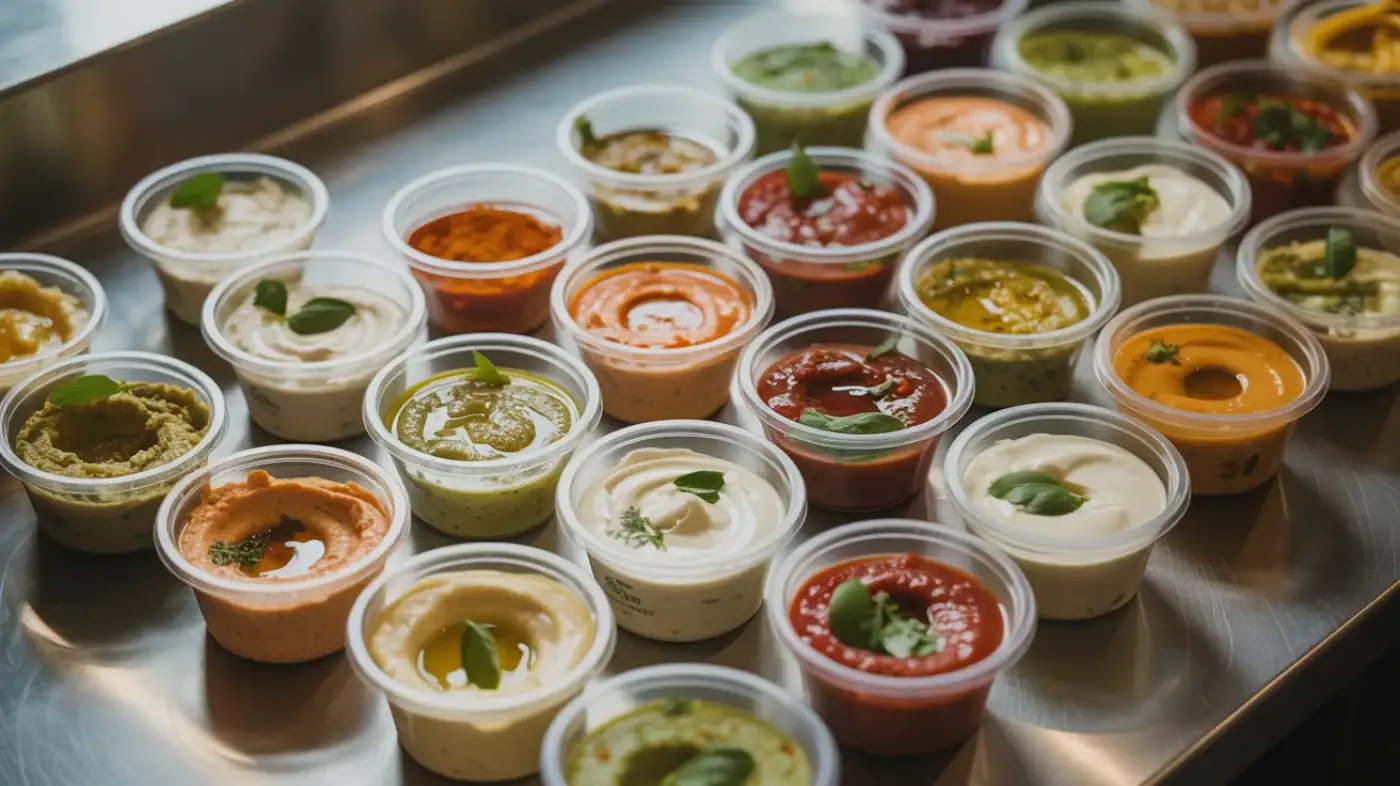
Soup Filling Machine for Refrigerated Soup, Broth and Chili Cups
Portion chilled soups, bone broth, chowder and chili into pre-formed cups, then seal and lid every cup on the same rotary turret. Servo piston filling holds ±0.5% on 50-500 g portions, and large-bore valving carries chunky recipes.
A soup filling machine doses a target fill weight of soup, broth or chili into pre-formed cups and seals each one for refrigerated sale. Hummus Pack's SDH-R is a rotary soup filling machine: its servo-driven piston doses 50-500 g within ±0.5%, large-bore valving carries vegetable and bean pieces, and heat-sealed film closes every cup at up to 30 cups per minute. A single-filler SDH-R is priced from $45,000 USD.
- Machine
- SDH-R automatic rotary cup filling, sealing and lidding
- Soup fill range
- 50-500 g per cup (approx. 2-17 oz) standard
- Fill accuracy
- ±0.5% with a servo-driven volumetric piston
- Output
- Up to 30 cups/min dry cycle; 18-25 in production
- Soup cups
- 4, 8, 10, 16 oz standard; custom tooling 2-32 oz
- Closures
- Heat-sealed membrane from roll film; optional snap-on lid
- Price
- From $45,000 USD (single filler)
What a Soup Filling Machine Does for Cup-Packed Soup
A soup filling machine doses a target weight of soup, broth, stew or chili into a pre-formed cup and closes it for the refrigerated case, the grab-and-go cooler or a foodservice line. Our SDH-R does both on one rotary turret: the servo-driven volumetric piston doses each portion between 50 and 500 g within ±0.5%, then roll-fed film is heat-sealed across the rim before an optional snap-on lid goes on. See the full machine on our SDH-R product page.
Soup is harder to fill than thick dips such as hummus. A ladle-thin broth moves every time the turret indexes, and a chunky minestrone wants to separate into liquid and vegetables. If you are still comparing formats, our cup filling and sealing machine overview is a good starting point.
Thin Broth, Cream Soup or Chunky Chili: Matching the Soup Filler to the Recipe
Broth cup filling: clear broths and bone broth
Broths behave almost like water: easy to meter, quick to splash and drip. A positive-displacement piston delivers the same volume whether product is thin or thick, and a suck-back nozzle pulls the last liquid back at the end of the stroke so nothing tails onto the flange. Collagen-rich bone broth flows when warm and sets to a soft gel in the cooler, so a partly gelled broth sloshes less but must still pump from the hopper.
Cream soups, bisques and purees
Tomato bisque, butternut squash and a chilled vichyssoise sit mid-range in viscosity and fill cleanly, often through a cut-off nozzle. Watch for air drawn in by upstream transfer pumps, which leaves cups light, and for cream separating if product waits too long in the hopper.
Chunky soups, stews and chili
Minestrone, chicken noodle, beef stew and bean chili carry vegetables, pasta, legumes and meat. Large-bore valving passes particulates, sized to the largest piece in your recipe; maximum particle size is confirmed with our engineering team. The harder issue is consistency, because solids settle in a liquid carrier and early cups can run broth-heavy. Keeping solids suspended is a process and hopper-feeding question we work through with you, for example matching batch size to hopper turnover and feeding from an upstream kettle that keeps product moving. For some recipes a split fill is worth evaluating, with one of up to three fillers dosing the chunky component and the piston filling machine station adding broth around it.
Soup Packaging Machine Setup by Product Type
Use this table to open a quote conversation; every recipe is still checked for viscosity, particle size and fill temperature.
Soup products and a typical SDH-R starting configuration
| Product | What makes it tricky | Typical starting setup |
|---|---|---|
| Chicken or vegetable broth | Water-thin; splashes and drips | Suck-back nozzle, generous headspace, membrane plus snap-on lid |
| Bone broth | Gels when chilled; floating fat | Fill temperature agreed with engineering; fat kept off the flange |
| Bisques and cream soups | Air from upstream pumps; milk allergen | Cut-off nozzle; weight checker with feedback loop |
| Gazpacho and vichyssoise | Filled cold; fine vegetable pieces in gazpacho | Large-bore valving; nitrogen only with a validated shelf-life plan |
| Minestrone and chicken noodle | Solids settle; pasta keeps absorbing broth | Large-bore valving; hopper turnover plan; split fill evaluated |
| Chili and beef stew | Heavy pieces; dense fills near the 500 g ceiling | Large-bore valving; cup chosen by weight, not volume |
Splash, Slosh and Clean Flanges: Making the Soup Cup Sealer Work
Most soup seal failures start before the sealing station. A rotary turret indexes: it accelerates, stops for the fill, then moves again to the sealing head. Thick dips ignore that motion. Thin broth answers it with a wave that climbs the cup wall, and a wet flange is where leakers start. On a soup filling machine, these choices keep the flange dry:
- Headspace. Leave room between fill line and rim for the liquid to move. For broth that can mean a slightly larger cup for the same fill weight.
- Nozzle and height. A suck-back nozzle stops the drip after cutoff, and nozzle height is set at commissioning so the stream does not rebound off the cup base.
- Stroke speed. The servo-driven piston lets us slow product entry for a calmer surface.
- Machine speed. Thin liquids in large cups usually run toward the low end of 18-25 cups per minute so the surface settles between stations.
Floating fat in bone broth, chowder and chili stops the film bonding as surely as liquid does, and warm product adds steam condensing on the flange. With a clean flange, seal quality depends on sealing temperature, pressure and dwell, tuned for your film and cup and stored in each HMI recipe. The sealing station gets a deeper treatment on our automatic cup sealing machine page.
Grab-and-go soups are often reheated in the container, so confirm microwave suitability of film and cup with your packaging supplier; we then set the soup cup sealing machine parameters to match. A membrane under a snap-on lid adds tamper evidence and reclosability.
Get a configured SDH-R quote for your productSend your product, cup size and target cups per minute — we reply within 24 hours.
Request a quoteSoup Cup Sizes and Fill Weights on a Soup Cup Filling and Sealing Machine
Soup cups are sold by nominal volume, but the filler is set by weight, and the standard SDH-R fill range ends at 500 g. Most soups weigh close to water, about 1 g per mL, with cream and chunky soups a little heavier:
- 8 oz and 10 oz cups (about 237 and 296 mL): roughly 240 g and 300 g, well inside the range and both standard sizes.
- 12 oz cups (about 355 mL): a common single-serve soup size, available as custom tooling, at roughly 360 g.
- 16 oz cups (about 473 mL): roughly 470 g of broth and more for dense chili, the very top of the standard range, so we check fill weight against your recipe.
- 24 oz and 32 oz cups (about 710 and 946 mL): 700 g to over 900 g, beyond the 500 g standard range. Custom tooling reaches 32 oz, but large-format soup fills are confirmed with our engineering team before quoting.
Round cups dominate soup, though square and rectangular tooling is available; containers arrive pre-formed, because the machine does not thermoform. For family-size formats see our tub filling machine page.
Fill Temperature, Cooling and Food Safety for Cup-Packed Soup
The SDH-R carries no hot-fill rating, and we publish no maximum fill temperature for it. Its design target is fresh and refrigerated product at a pumpable temperature, and our engineering team confirms the fill temperature for each soup before quoting. That matches how most refrigerated soup is made: cooked, cooled, then portioned.
Cooling is a key hazard-control step. Spores of Clostridium perfringens and Bacillus cereus survive cooking, and a batch that cools slowly lingers where they germinate and multiply. Under the FDA's Preventive Controls for Human Food rule (21 CFR Part 117) or a HACCP plan, cooling of cooked soup is commonly a process control with validated time and temperature limits. The FDA Food Code, written for retail and foodservice, is a common reference: 135°F to 70°F within 2 hours, and to 41°F or below within 6 hours in total.
Plants that fill warm and rapid-chill sealed cups rely on their own validated thermal process, not the filler, and a warm fill adds flange condensation, so bring that plan to the quote. Meat or poultry soups may fall under USDA FSIS rather than FDA inspection. In Canada, the same logic sits in the preventive control plan required by the Safe Food for Canadians Regulations. Our HACCP planning guide shows where filling and sealing fit in a hazard analysis.
Nitrogen Flushing and Shelf Life for Refrigerated Soups
Optional nitrogen flushing brings residual oxygen inside the sealed cup down to 0.3-0.4%, slowing oxidation of fats and flavors. A typical refrigerated product moves from a 7-10 day life to 30-45 days or longer, product by product, but soup needs a careful reading of that range.
Most soups are low-acid. Nitrogen-flushing a low-acid soup creates reduced-oxygen packaging, which brings Clostridium botulinum into the hazard analysis: nonproteolytic strains can grow and produce toxin at refrigeration temperatures, often without obvious spoilage. A longer date therefore needs a validated barrier, such as acidity or salt controls, strict temperature control, a limited shelf life or challenge-study evidence, set by your food safety team or process authority.
Our guide to shelf-life testing for food products covers that work, while the flush hardware is described on our MAP cup filler page.
Allergens, Sanitation and Changeover on a Soup Filling Line
One soup week can cross milk in chowders, wheat in noodle soups, crustacean shellfish in lobster bisque, fish in seafood chowder, soy in miso and sesame in some Asian-style broths. Under the FASTER Act, sesame joined the eight FALCPA allergens as the ninth major US food allergen from January 1, 2023.
Product-contact construction is food-grade 304 stainless, the machine strips down without tools, and CIP is available as an option. Changeover between soups with the same allergen profile takes under about 15 minutes, since each soup's fill and seal values are recalled from the HMI; an allergen change runs to your validated sanitation procedure. With CE marking, UL listing and FDA-compliant food-contact materials, the SDH-R is built to support soup plants operating under HACCP, FSMA, SFCR, SQF and BRCGS programs, though it holds no certification under those schemes itself. Our certifications and compliance page lists the specifics.
When a Different Soup Packaging Machine Is the Better Choice
Candor about fit saves both sides time. Look elsewhere for these programs:
- Shelf-stable soup. Canned, retort-pouch and aseptic carton soups are thermally processed low-acid foods under 21 CFR Part 113. The SDH-R is not a retort or aseptic system.
- Pouches, bottles and jars. Sipping-broth bottles, soup pouches and jars need a different filler; the SDH-R fills pre-formed cups and tubs only.
- Very high single-SKU volume. Well above 30 cups per minute all day calls for a multi-lane line; our inline cup filling machine page explains when that pays.
- Bulk and frozen programs. Gallon pails sit outside the 500 g range, and the SDH-R targets fresh and refrigerated cups, so raise any downstream freezing with our engineers early.
The SDH-R fits a deli commissary, regional soup brand or co-packer running a shared cup line that packs several refrigerated soups and chilis in 8-16 oz cups, changes flavors mid-shift, and wants weight control and a tamper-evident seal without a long inline line. Kitchens that fill soups and sauces on one machine should also read our sauce filling machine page.
Specifying and Quoting a Soup Filling Machine
A single-filler SDH-R is priced from $45,000 USD; extra fillers, nitrogen MAP, labeling, coding, CIP and custom tooling add to that. Lead time is 8-12 weeks, a 12-month warranty applies, and after-sales service runs from our service centres in Alberta, New Jersey and California. Designed and built in Calgary, it needs 44 × 52 in of floor and 65.6 in of height. To quote your soup filling machine, send our sales team:
- Each soup, its consistency and its largest particle size
- Planned fill temperature
- Cup size, shape and material, plus film or lid
- Target fill weight and cups per minute
- Options: second filler, nitrogen, lids, labeling, coding, weight checker
- Allergen mix and cleaning approach
We may ask about your process before quoting; expect a reply within roughly 24 hours. Phone +1 (888) 922-7271, or use our online form to request a soup filling machine quote.
Sources and review
Every SDH-R figure on this page is checked line by line against the SDH-R engineering specification, as set out in our editorial policy. The regulatory and food-safety notes rely on these official sources, which we checked when this page was last updated:
- FDA: FSMA Final Rule for Preventive Controls for Human Food
- eCFR: 21 CFR Part 117, Current Good Manufacturing Practice, Hazard Analysis, and Risk-Based Preventive Controls for Human Food
- eCFR: 21 CFR Part 113, Thermally Processed Low-Acid Foods Packaged in Hermetically Sealed Containers
- FDA: Food Code
- CFIA: Preventive controls and preventive control plans
- Justice Laws Website: Safe Food for Canadians Regulations (SOR/2018-108)
Regulatory information here is general guidance, not legal advice; confirm your obligations with the authority or a qualified advisor. Spotted something out of date? Email sales@hummuspack.com or call +1 (888) 922-7271.
Soup Filling Machine — Frequently Asked Questions
Our SDH-R soup filling machine is priced from $45,000 USD in single-filler form. Adding a second or third filler, nitrogen MAP, snap-on lidding, labeling, coding, CIP or custom cup tooling raises the price. Lead time runs 8-12 weeks after the order is confirmed, and the machine is covered by a 12-month warranty.
There is no hot-fill rating or published maximum fill temperature for the SDH-R. Its target is fresh and refrigerated soup at a pumpable temperature, which suits the usual cook, cool and portion sequence. If you plan to fill warm and chill sealed cups, our engineering team confirms the fit, and your validated thermal process stays the food safety control.
Usually, yes. On the SDH-R soup filling machine, large-bore valving carries diced vegetables, beans and meat pieces, with valve and nozzle sized to your largest piece. Consistent solids-to-broth ratio from cup to cup depends on hopper feeding and batch management, which we review with you. Maximum particle size is confirmed with our engineering team before quoting.
The SDH-R's standard tooling covers 4, 8, 10 and 16 oz cups, and custom change parts span 2-32 oz. For soup the real limit is usually weight: standard fills run 50-500 g, so a 16 oz cup sits at the top and 24 oz or 32 oz soup cups normally exceed it. Large formats are confirmed with our engineers.
Dry-cycle speed on the SDH-R tops out at 30 cups per minute; with real soup, plan on 18-25. Thin broths in large cups tend toward the lower end because the surface must settle between stations to keep the flange dry. At 20 cups per minute, a soup filling machine packs 1,200 sealed cups an hour.
The SDH-R's optional nitrogen flush leaves 0.3-0.4% residual oxygen in the cup, which slows oxidation. For low-acid soups, reduced-oxygen packaging requires validated Clostridium botulinum controls, such as formulation barriers, strict refrigeration, a limited shelf life or challenge testing. Set each soup's shelf life by testing rather than assuming it from the flush.
No. The SDH-R is a cup and tub machine for fresh and refrigerated foods. It performs no retort or aseptic processing, so shelf-stable soups regulated as thermally processed low-acid foods need another line, and it cannot fill pouches, bottles, jars or cans. We say so early when a soup project falls outside that scope.
Switching between soup SKUs on the SDH-R takes under about 15 minutes, since each soup's fill volume and seal values live in an HMI recipe. A change across allergens, such as a cream chowder followed by a dairy-free broth, needs a full clean under your validated sanitation procedure, made easier by 304 stainless construction, tool-free strip-down and optional CIP.
Related machines & guides
Explore the pages most relevant to this application.
Why producers buy from Hummus Pack
Ready to Quote Your Soup Filling Machine?
Get a personalized SDH-R configuration and price for your product, cup sizes, and production volume.